Prophetic Dreams Across Cultures: A World History
On every inhabited continent, in every century we have records for, people have gone to sleep hoping the night would tell them something about tomorrow. A prince napped in the shade of the Sphinx and woke with a promise of the throne. Greek pilgrims slept in temples waiting for a healing dream. A Roman consul's wife begged her husband to stay home on the day he was killed. Lakota seekers fasted alone on a hill, crying for a vision, and in Japan the very first dream of the new year is still read as a forecast of the twelve months ahead.
This is a tour of how humanity has read dreams of the future: Egypt and its oldest surviving dream book, Mesopotamia and Greece, Rome's most famous warning dream, the rich and often misunderstood dream traditions of North America and Australia, East Asia's dream dictionaries and lucky first dreams, the Abrahamic scriptures, and the strange modern experiments that tried to turn premonitions into an early warning system. Two things stay constant across four thousand years: people record their dreams, and people argue about the hits.
Egypt: The Prince, the Sphinx and the Oldest Dream Book
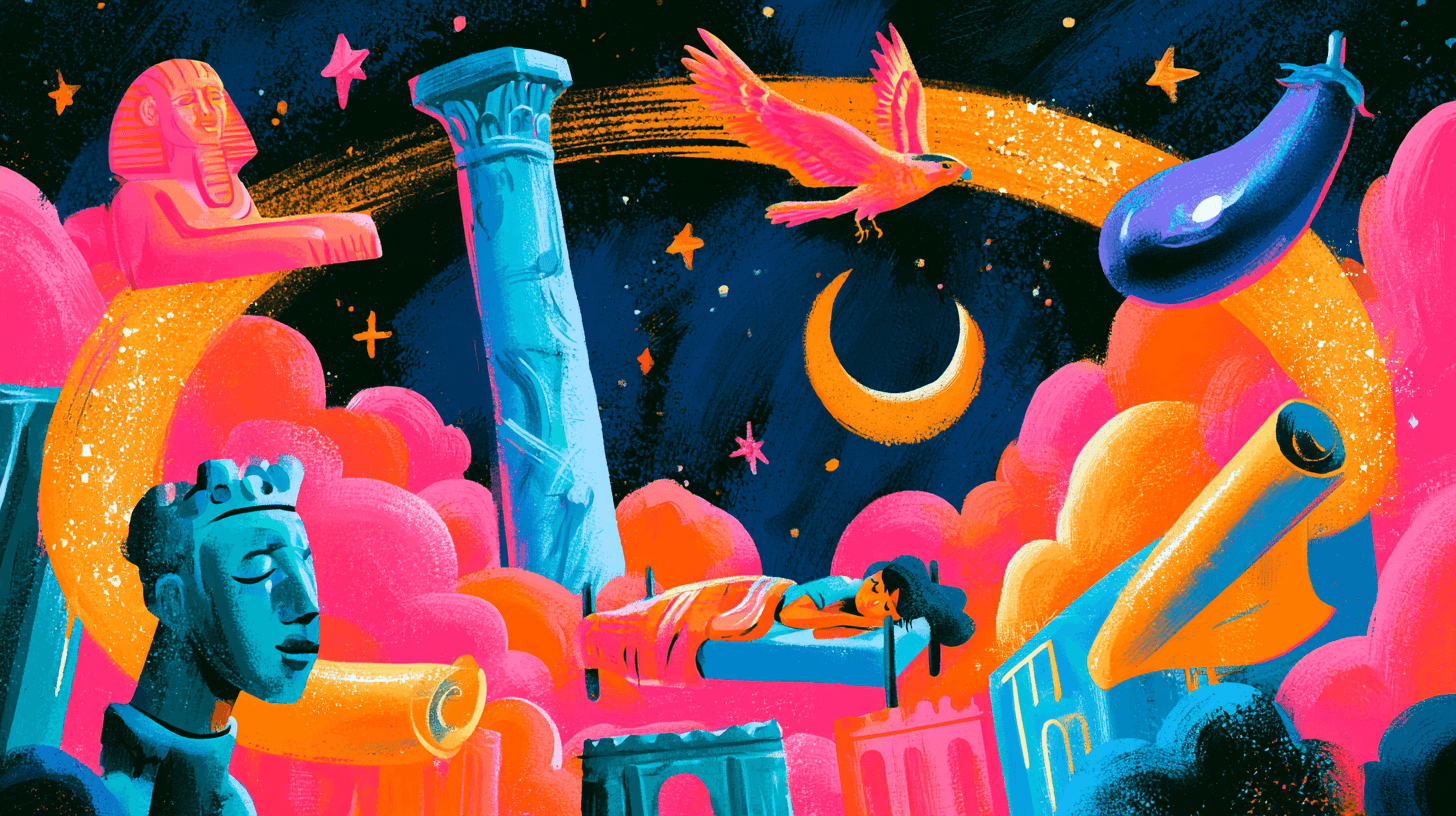
Around 1400 BC, a young Egyptian prince named Thutmose went hunting near Giza and fell asleep in the shade of the Great Sphinx, which by then was buried up to its neck in desert sand. In his dream, the Sphinx spoke: clear away the sand that smothers me, and I will make you king. Thutmose restored the monument, and he did become pharaoh, Thutmose IV, even though he does not appear to have been first in line. We know the story because he carved it in stone: the Dream Stele still stands between the Sphinx's paws today. Historians read it as brilliant politics, a dream used to legitimise an unlikely succession, and that reading makes the deeper point: a dream could carry that much authority in Egypt because everyone accepted that gods spoke through them.
Egypt also left us the oldest dream manual that survives: a papyrus from around 1220 BC, known today as the Ramesside Dream Book from the Chester Beatty papyri, now in the British Museum. Its format is instantly recognisable to anyone who has opened a dream dictionary since: line after line of 'if a man sees himself in a dream' doing this or that, each ruled good or bad, with the bad ones sometimes accompanied by a small ritual to cancel the omen. Three thousand years before modern dream apps, dreaming already had reference literature.
Mesopotamia and Greece: Messages and Medicine
The oldest dreams in world literature belong to Mesopotamia. In the Epic of Gilgamesh, the hero dreams of a meteor falling from the sky and of a great axe, and his mother, the goddess Ninsun, interprets both: a mighty friend is coming, the wild man Enkidu who will change his life. Mesopotamian kings recorded message dreams from the gods before battles and building projects, scribes compiled dream omen lists, and professional interpreters held official standing. The pattern that Egypt set holds here too: dreams mattered enough to be written down, catalogued and consulted like state intelligence.
The Greeks industrialised something gentler: the healing dream. At the sanctuaries of Asclepius, the god of medicine, most famously at Epidaurus, the sick travelled from across the Mediterranean to sleep inside the temple precinct, a practice called incubation. The hope was a dream in which the god visited, touched the afflicted part or prescribed a cure, and the temple walls filled with inscriptions from grateful patients describing exactly such dreams. Whatever one makes of the cures, the sanctuaries ran for centuries, which makes incubation one of the longest continuously operating dream practices in history.
Greece also produced both the first great dream manual of the West and the first great sceptic. In the second century AD, Artemidorus of Daldis travelled the festivals interviewing dreamers for his five-volume Oneirocritica, and drew a distinction interpreters still use: some dreams are theorematic, coming true exactly as seen, while most are allegorical, speaking in symbols that need decoding in the context of the dreamer's life. Five centuries before him, Aristotle had already written a short treatise on prophetic dreams and concluded, with striking modernity, that most are coincidence, some reflect the body's early signals of illness, and some fulfil themselves because the dreamer acts differently after dreaming. The ancient world was not naive: it contained the whole modern argument already.
Rome: Calpurnia and the Ides of March
Rome's most famous dream belongs to Calpurnia, wife of Julius Caesar. On the night of 14 March 44 BC, the ancient historians tell us, she dreamed of her husband's death, in one account holding his bleeding body in her arms, and in the morning she begged him not to attend the Senate. Caesar wavered, and according to Plutarch he very nearly stayed home, until a conspirator, Decimus Brutus, teased him for heeding a woman's dreams and led him out. He was stabbed to death that day, the Ides of March. Sixteen centuries later Shakespeare gave her warning its permanent form:
When beggars die, there are no comets seen; the heavens themselves blaze forth the death of princes.
Calpurnia, in William Shakespeare's Julius Caesar
Our sources wrote long after the event, and history polishes its best stories, so nobody can say what Calpurnia truly dreamed that night. But the story's survival is itself the evidence: Rome found it entirely believable that a death of that size would announce itself in a wife's sleep, because Romans lived inside a culture of omens in which dreams were a recognised channel of official warning.
North America: Vision Quests and the Wishes of the Soul
There is no single Native American view of dreams. North America holds hundreds of distinct nations with their own languages, ceremonies and living traditions, so any summary can only sample respectfully. Among the Lakota, the seeking of vision is a sacred rite called hanbleceya, often translated as 'crying for a vision': prepared and guided by a holy man, the seeker fasts alone on a hill, sometimes for days, praying for a vision that will reveal their path and their responsibilities. It is important to say what this is not: it is not fortune telling. The vision sought is direction rather than prediction, an understanding of one's place and purpose that the seeker may spend a lifetime growing into.
The most famous published account of such an experience belongs to Black Elk, an Oglala Lakota holy man. At the age of nine, during a severe illness in which he lay unresponsive for days, he experienced a vast vision of the powers of the world, one that the holy men of his community recognised as extraordinary and that he understood, for the rest of his long life, as the source of his calling. He recounted it decades later to the poet John Neihardt, and the resulting book, Black Elk Speaks, became one of the most read spiritual documents of the twentieth century. Whatever a reader's own beliefs, the shape of the tradition is clear and dignified: a great vision is not a lottery ticket about tomorrow, it is a responsibility about a whole life.
Further east, the Haudenosaunee (Iroquois) developed one of the most sophisticated dream psychologies anywhere. Dreams revealed the ondinnonk, the hidden wish of the soul, and a dream ignored meant a soul denied, with illness and misfortune to follow, so dreams were shared, discussed and acted upon, and a special dream-guessing rite formed part of the Midwinter ceremony. Seventeenth-century Jesuit missionaries recorded all this with astonishment in their reports home, and in 1958 the anthropologist Anthony Wallace argued in a famous paper that the Haudenosaunee had, in effect, worked out a theory of the dreaming mind's hidden desires centuries before Freud. Here the future-telling question almost misses the point: dreams were diagnosis and obligation, the soul telling the community what it needed next.
Australia: When 'Dreaming' Does Not Mean Dreams
Australia demands the tour's most important correction. The famous Aboriginal 'Dreamtime' is not about sleep at all. The word is a nineteenth-century English mistranslation of concepts such as Tjukurpa, which names the eternal ancestral order: the laws, stories, songs and beings that shaped the land and still hold it, a reality in which past, present and future exist together. Many Aboriginal people consider 'Dreamtime' misleading precisely because it makes a living law sound like something imaginary. Sleep dreams do matter in many Aboriginal traditions, including as a space of contact with country and with those who have passed, but the Dreaming itself is not a dream, and knowing the difference is a basic mark of respect. It is the tour's best reminder that the English word 'dream' has been made to carry far more than it can hold.
East Asia: The Duke of Zhou and the Year's First Dream
In China, dream interpretation carries the name of a statesman revered for three thousand years: the Duke of Zhou. The dream dictionary that bears his name, the Zhougong Jiemeng, was compiled long after his lifetime, but the attribution shows the prestige the subject held, and the book is still consulted today, now mostly through websites and apps. His name even entered everyday speech: Chinese speakers still joke about 'going to see the Duke of Zhou' when someone dozes off. Few cultures have kept a dream book in continuous popular use for so long.
Japan keeps the calendar's most charming prophetic dream: the hatsuyume, the first dream of the new year, read as an omen for the twelve months ahead. An old proverb ranks the luckiest sights: first Mount Fuji, second a hawk, third an eggplant. The classic explanation ties all three to Suruga province, home of the shogun Tokugawa Ieyasu, famed for its great mountain, its hawks and its early aubergines, while wordplay helps too: the word for hawk sounds like 'high' and the word for eggplant like 'to achieve'. In earlier centuries, people even slipped a picture of the treasure ship of the Seven Lucky Gods under the pillow on New Year's night to invite a lucky dream, an entire nation, once a year, gently trying to rig its own forecast.
The Abrahamic Thread
The scriptures of the Abrahamic faiths carry the same conviction into theology. In the Hebrew Bible and the Christian tradition, Joseph reads Pharaoh's dream of fat and lean cows in time to save Egypt from famine, Daniel interprets the dreams of kings in Babylon, and in the Gospels a dream warns Joseph to carry his family to safety; we walk through all of it in our guide to dreams in the Bible. Islam gives the true dream its most precise framework of all, honouring the ruya sadiqa as a remnant of prophetic light while ruling most dreams ordinary and protecting believers from fear; that teaching has its own guide, true dreams in Islam. Across both, the pattern of this whole tour repeats: the dream is honoured, and the dreamer is disciplined about which dreams count.
From Temple Steps to Filing Cabinets
The impulse never went away; it just changed furniture. In the 1960s, after a Welsh schoolgirl's dream preceded the Aberfan disaster, a British psychiatrist opened an actual Premonitions Bureau where the public could register dreams before events, and New York soon ran its own registry: the ancient temple porch reborn as a filing cabinet. The full story, with what the experiment found and what science says about dreams that seem to come true, is in our companion guide, can dreams predict the future. But notice what every stop on this tour shares, from the Dream Stele to the Ramesside papyrus to the temple inscriptions of Epidaurus to a bureau's date-stamped index cards: the conviction that a dream is worth recording. The pharaoh had a stele. Dunne had a notebook. The tradition, at least, is unanimous about the first step.

Get Ruya App
Track your dreams anywhere and unlock deeper insights.
Prophetic Dreams Across Cultures: Frequently Asked Questions
Which cultures believed dreams could predict the future?
What is a vision quest?
Is the Aboriginal Dreamtime about dreams?
What is the oldest dream book in the world?
What did the Iroquois believe about dreams?
What is hatsuyume, and why Mount Fuji, a hawk and an eggplant?
Four thousand years of dreamers agree on very little: the Sphinx promises thrones, the Haudenosaunee hear the soul's wishes, Aristotle counts coincidences, and Japan bets the year on an eggplant. But they agree completely on the habit. A dream you want to understand is a dream you write down, dated, before the day gets its hands on it. That habit is older than most alphabets, and it is the one part of the tradition you can practise tonight: Ruya gives you a private, dated dream journal and, when a dream feels like more than a dream, interpretation methods drawn from psychology and the world's spiritual and religious traditions.
Was this article helpful?