hotel_classFEATURED ARTICLE
Christmas Dreams: What Dreaming About Christmas Means
You wake in a dark room, and a moment ago it was Christmas. There was a tree, or a table full of people, or a present you could not open, or a Christmas you were late for. Maybe it is December and the dream makes sense. Maybe it is July and you have no idea where it came from.
Here is the short answer. A Christmas dream is almost never about Christmas itself. It is about the things Christmas gathers in one place: family, home, childhood, money, gifts, the people missing from the table, and the feeling that you are not ready. In December it is also made stronger by late nights, heavy meals and alcohol, which change how you sleep and how much you remember. Here is what science, psychology, spiritual and Christian readings make of it, and what to do with yours.
Why Christmas dreams feel so vivid
Start with alcohol. A 2013 review of sleep studies on healthy adults, led by Irshaad Ebrahim, found that alcohol before bed helps people fall asleep faster and deepens sleep in the first half of the night, but it delays the first period of REM sleep, the stage in which most vivid dreaming happens, and at higher doses it cuts early REM sleep. In the second half of the night sleep becomes more broken at every dose. An earlier review by Timothy Roehrs and Thomas Roth explained why: once the body has cleared the alcohol, usually four to five hours after falling asleep, REM sleep comes back in longer periods than normal, with more waking in between. That is why the dreams you remember after a party are long and intense.
Then there is the Christmas timetable: late heavy meals, a bedtime that moves every night, long mornings in bed. A 2022 analysis of the American Time Use Survey found that people who ate or drank within an hour of going to bed were about twice as likely to lie awake for more than 30 minutes during the night. Broken sleep matters because of a fact established in 1957 by William Dement and Nathaniel Kleitman: people woken during REM sleep report a dream about four times in five; people woken from other stages of sleep almost never do. More waking means more dreams remembered.
What about the food itself? The cheese question was finally studied properly in 2025, when Tore Nielsen's dream laboratory in Montreal and Russell Powell at MacEwan University in Canada surveyed 1,082 students about diet, sleep and dreams. Only 5.5% believed food changed their dreams, and those who did mostly blamed dairy and desserts. The clearest finding was that students with lactose intolerance had more nightmares and worse sleep, and that the link ran through the stomach: once the researchers took account of digestive symptoms, the connection disappeared. Cheese does not put pictures in your head; an upset stomach wakes you more often, and waking more often means remembering more bad dreams. This was a survey, so it shows an association, not a cause, and the authors say so.
The famous "cheese gives you nightmares" experiment showed nothing of the kind. In 2005 the British Cheese Board, a trade body, gave 200 volunteers 20 grams of cheese half an hour before bed. It announced that nobody had a nightmare, that 67% remembered their dreams, and that Stilton produced the strangest ones. The exercise was never published in a scientific journal. It was a publicity campaign, and it is still quoted as science.
The idea is much older. In A Christmas Carol (1843), when Marley's ghost appears, Scrooge tries to explain it away as indigestion.
A slight disorder of the stomach makes them cheats. You may be an undigested bit of beef, a blot of mustard, a crumb of cheese, a fragment of an underdone potato. There's more of gravy than of grave about you, whatever you are!
Charles Dickens, A Christmas Carol (1843)
Christmas and dreaming have been linked ever since. "The children were nestled all snug in their beds, while visions of sugar-plums danced in their heads" comes from "A Visit from St. Nicholas", printed anonymously in 1823 and later credited to Clement Clarke Moore. The Nutcracker, a story by E. T. A. Hoffmann in 1816 and Tchaikovsky's ballet in 1892, takes place on Christmas Eve, and in many productions the whole adventure is a child's dream.
What a Christmas dream is usually about
Dreams mostly use the material of our days. Researchers call this the continuity hypothesis, and diary studies such as Michael Schredl and Friedrich Hofmann's 2003 work find that it holds best for what you spend time on and feel strongly about. From late November, Christmas fills everything: shops, songs, adverts, family messages, the calendar. So the first explanation for a Christmas dream in December is that Christmas is everywhere. The better question is which part of it your dream chose.
- Nostalgia and the childhood home. Many Christmas dreams happen in the house you grew up in, with the decorations and people of that time. Psychologists usually read this as a longing for a time when someone else carried the responsibility and you were simply looked after. It is common after a hard year.
- The unfinished list. It is Christmas morning, nothing is wrapped, the shops are shut and the guests are at the door. This works like the exam dream: being judged on something you feel unprepared for. It arrives when the real list is long and you are the one holding it.
- Family in a small space. Christmas puts people who do not usually live together into one house for days. Dreams of an argument at the table or a door you cannot close usually rehearse a tension you expect, not one that has happened.
- The first Christmas after a loss. If someone has died, the first Christmas without them is one of the hardest days of the year, and the dream often puts them back in their chair. This is grief doing its work. Our guide to dreaming of someone who has died explains why these dreams come and why they usually help.
- Being alone. An empty table, or watching other people's Christmas through a window, usually says that you feel left out of something right now, whether or not you will actually be alone on the day.
- Money. Presents you cannot afford, a bill you cannot pay. Christmas is the most expensive time of the year for many families, and the dream makes the pressure visible.
Two figures need a note. Some writers describe Santa Claus as the ideal parent: a figure who knows what you have done all year, judges you kindly, and gives without being asked. A dream in which he is kind, absent or frightening can then be read as a dream about being looked after, or about who is looking after you now. That is a reading, not a research finding. The evergreen tree is the other. Evergreens were part of northern European winter customs long before the Christmas tree, first recorded among German Lutherans in the sixteenth century, and in Christian use the tree stands for eternal life: something green and alive in the darkest month. A healthy, decorated tree in a dream usually says that something in you is still alive and well; a bare or fallen one says the opposite.
In every case the reliable clue is the feeling. A warm Christmas dream points to something you miss or want, a frantic one to a load you are carrying, a sad one to a person or a time you have lost. Match the feeling to your life this week, and the dream usually explains itself.
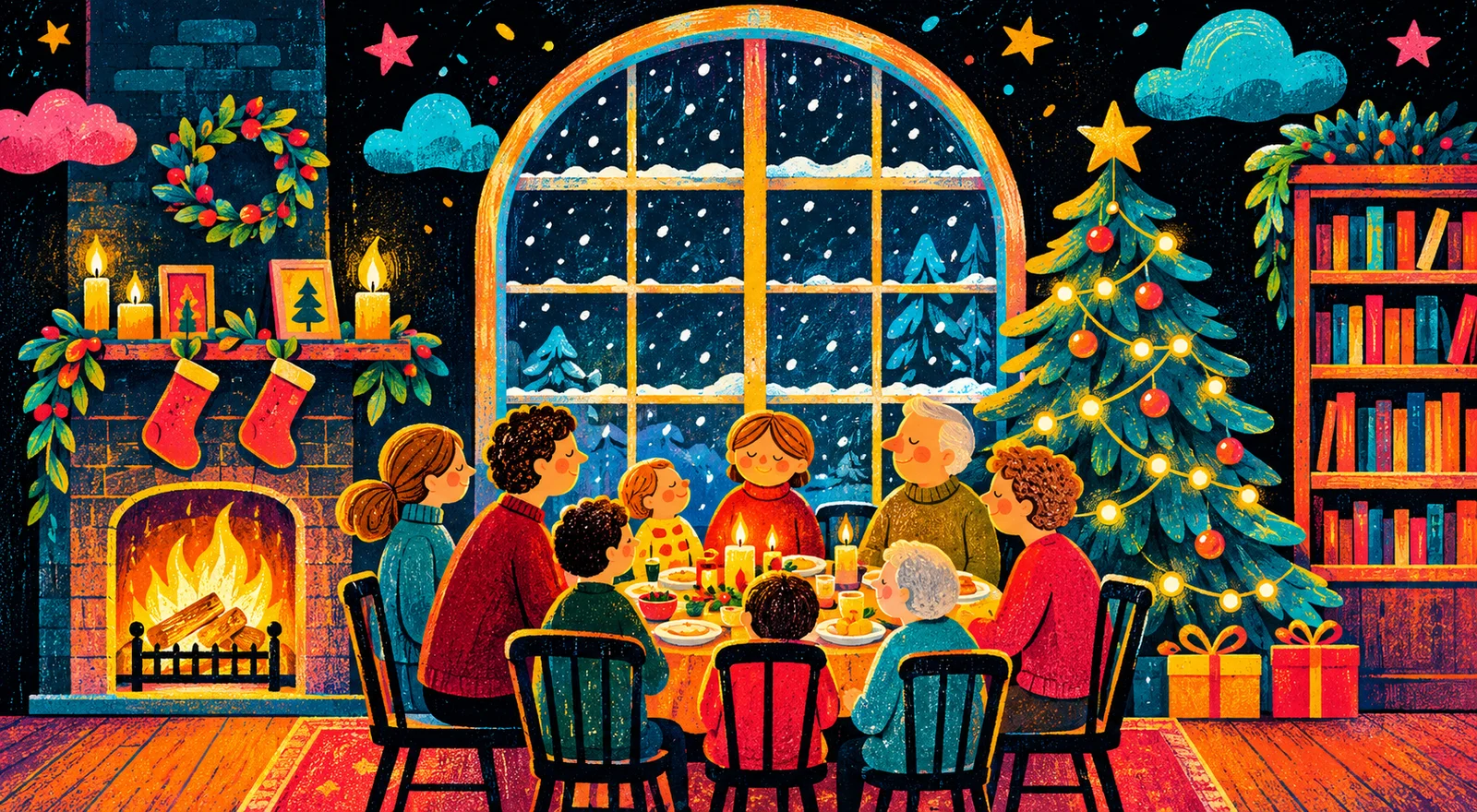
Versions of the dream and what they usually point to
The details decide the meaning. Each version below is a question for you to answer, not a prediction.
| The dream | What it usually points to |
|---|---|
| A Christmas tree: decorated, bare, or falling over | A decorated tree is your life in order. A bare tree says the season, or a part of your life, has lost its warmth. A falling tree is the fear that everything you hold up will come down at once. |
| Presents: giving, receiving, or an empty box | Giving is wanting to be appreciated, or to make up for something. Receiving is what you need from others. An empty box is a disappointment you expect: a promise you do not believe will be kept. |
| Santa Claus: kind, absent, or frightening | Kind: you want someone to take care of things for a while. Absent: nobody is doing that. Frightening: a parent or a person in authority is on your mind, and your feelings about them are mixed. |
| Snow and a white Christmas | Quiet, a clean start, the world paused. Often a wish for rest. If the snow traps you or buries the house, it is about being cut off, not peace. |
| An empty table, or being alone at Christmas | Feeling left out or unwanted. The dream usually makes a small real loneliness look much bigger. Ask who you would want at the table. |
| Christmas with an ex, or with someone who has died | With an ex: a season you once shared, remembered when the season returns; rarely a wish to go back. With someone who has died: grief making room for them on the day they are missed most. |
| Christmas out of season, in the middle of summer | Usually a wish for the feelings Christmas brings (rest, company, being given something) when life offers none of them. Not a sign; see the spiritual section. |
| Missing Christmas, or being late for it | The classic "not ready" dream, close to the exam dream. Something with a fixed date is coming and you fear you will not be prepared, or have already missed your chance. |
Spiritual meaning of a Christmas dream
Spiritual traditions read a Christmas dream through light. Christmas comes a few days after the winter solstice, on 21 or 22 December, the longest night of the year in the northern hemisphere. Cultures across the northern world mark it with festivals of light: the Roman Saturnalia, the Germanic Yule, the Persian night of Yalda, the Chinese Dongzhi festival, and, in the late Roman Empire, the feast of the Unconquered Sun on 25 December. In parts of Europe the solstice was seen as the death and rebirth of the sun. The idea is the same everywhere: at the darkest moment the light turns and begins to come back. In spiritual readings a Christmas dream carries that message: something that has felt dark is about to turn. The second theme is generosity: the dream asks what you are giving, and what you are willing to receive.
There is also a folk belief, kept alive in German-speaking Europe, that dreams on Christmas night and in the twelve nights after it, up to 6 January, say something about the year ahead, one night for each month. Ruya's Signs & Synchronicities method has a plain rule for such traditions: a dream is an ordinary dream until it gives a good reason to think otherwise. A Christmas dream in July, after a hot day and a Christmas film on television, is your mind using a familiar picture, not a message. A dream that repeats, leaves a feeling that stays with you all day, and matches something real in your life deserves more attention. For the long history of dreams believed to foretell events, see our guide to prophetic dreams across cultures.
The Christmas story is full of dreams
For Christian readers the connection is direct: the Christmas story in the Gospel of Matthew is told through dreams, five of them. Joseph, who plans to end his engagement to Mary quietly, is told in a dream to take her as his wife and to name the child Jesus (Matthew 1:20-21). The Magi are warned in a dream not to go back to King Herod (2:12). Joseph is told in a dream to take the child and his mother and escape to Egypt (2:13). After Herod's death he is told in a dream to return (2:19-20). And when he is afraid of the new ruler of Judea, he is warned in a dream once more and settles in Galilee (2:22). Without these dreams, as Matthew tells it, the family does not survive the first Christmas.
When they had gone, an angel of the Lord appeared to Joseph in a dream. "Get up," he said, "take the child and his mother and escape to Egypt. Stay there until I tell you, for Herod is going to search for the child to kill him."
Matthew 2:13, NIV
There is an older parallel. Matthew's Joseph shares his name with Joseph the son of Jacob, the great dreamer of Genesis, whose dreams of bowing sheaves and of the sun, moon and eleven stars turned his brothers against him and took him to Egypt (Genesis 37:5-11). Both Josephs dream, both go to Egypt, both save their family. Christians see a pattern: at the turning points of the story, God speaks through dreams to ordinary people and gives practical instructions. Most Christian teachers today would not call your dream about Christmas a message. The dreams in Matthew are rare, specific and confirmed by events; a dream about the festival is almost always the mind at work, and no dream is placed above Scripture. Our guides to biblical dream interpretation and to whether dreams can predict the future explain how believers test a dream and what the evidence says.
A note for Muslim readers. Christmas is not an Islamic festival, and the classical compilations attributed to Ibn Sirin do not discuss it; the online pages that credit Ibn Sirin with a meaning for Christmas trees are modern, not the classical text. A Muslim who dreams of Christmas is dreaming of a festival, lights, food and family, and the Islamic method reads it like any festive dream: most often as a dream from the dreamer's own thoughts and surroundings, and never as a reason to act. The same three questions apply: what did you feel, what in your life does it match, and does it come back.
What to do with a Christmas dream
A single Christmas dream needs no action. If it was intense, upset you, or comes back every December, these steps help, in this order.
- Write it down the same morning. Note the setting (which house, which year), who was there, who was missing, and how you felt when you woke. Our guide to remembering your dreams has the method. Three or four entries show what the dream is really about.
- Name the feeling in one word. Warm, frantic, sad, left out, trapped. The feeling tells you which reading above applies, and it is more reliable than any symbol.
- Check the holiday load. Write down what you are actually carrying: shopping, cooking, money, travel, people you have to see. A frantic Christmas dream is usually this list in picture form. Give one item to someone else.
- Fix the sleep, not the dream. Stop drinking alcohol three to four hours before bed, so that your body has cleared it before the second half of the night. Eat the big meal earlier. Keep your usual wake-up time, even after a late night. Get daylight in the morning. These habits reduce both the broken sleep and the vivid dreams.
- If the dream is about someone you have lost, say so. Tell one person that you dreamed about them, and that you miss them at this time of year. Grief dreams become gentler once they have been spoken about.
- If nightmares continue, get help. Nightmares that go on after the season has ended, or dreams that leave you anxious all day, are worth a conversation with a doctor or a therapist. Our guide to anxiety dreams covers what helps in the meantime.

Christian Dream Interpretation
Wondering what your dream means in the light of Scripture? Share your dream and receive a thoughtful interpretation rooted in the Bible.
A dream about Christmas is not a prediction, and it is not a judgement on how your Christmas will go. It is the mind using the brightest, most emotional picture it owns to show you something about home, family, loss or the load you carry. To work out what your own dream is about, write it down in Ruya and look at it through the method that fits how you see dreams: cognitive, Jungian, spiritual, Christian or Islamic. Our guide to how dream interpretation works explains the eleven methods. Different viewpoints, one dream, and an answer that is yours.
Christmas dreams: questions people ask
What does it mean when you dream about Christmas?
Why do I dream about Christmas in July?
Is dreaming about Christmas a good sign?
Why are my dreams so strange over Christmas?
What does it mean to dream of Santa Claus?
Does cheese really give you nightmares?
Was this article helpful?