hotel_classFEATURED ARTICLE
Dreaming You Are Naked in Public: What It Means
You are at work, or back at school, or walking down a street you know well, and at some point you look down and realise you have nothing on. Nobody handed you a towel. Nobody even seems to notice. You spend the rest of the dream trying to cover yourself, find your clothes or get out of the room, and you wake up with your heart going and a feeling that is somewhere between a laugh and a cringe. Dreaming you are naked in public is one of the oldest dreams on record and one of the most common. This guide looks at what sleep research has actually counted, what psychology reads in the dream, how spiritual traditions, Islam and the Bible interpret it, what the common versions tend to mean, and what to do when it keeps coming back.
What research says about naked dreams
Sleep researchers have a tool for exactly this kind of question: the Typical Dreams Questionnaire, a list of 55 dream themes that people are asked whether they have ever experienced. When Tore Nielsen, Antonio Zadra and their colleagues gave it to 1,181 Canadian university students, roughly a third said they had dreamed of being nude. A German study led by Michael Schredl a year later, using the same list, put the figure at just over four in ten. Whichever sample you trust, being naked sits comfortably among the most widely shared dreams, in the same group as falling, being chased, flying and arriving late for an exam.
Two details from that research change how the dream should be read. First, it is a lifetime figure, not a nightly one. When Schredl's group later asked nearly three thousand people to describe their most recent dream, the classic themes turned up far less often than the questionnaire suggests, and some of them only rarely. The naked dream is something most people have had, not something most people keep having, which is why a run of them is worth paying attention to. Second, it is not a women's dream or a men's dream. In the Canadian sample men reported it a little more often than women, 37.5% against 30.6%, and in the German sample the two were level. Whatever the dream is about, it is not about one sex's relationship with its body.
The oldest careful description of the dream belongs to Sigmund Freud, who gave it a section of its own in The Interpretation of Dreams. He noticed three things that still hold. The dreamer is usually only partly undressed, and the lack is vague: a missing shirt, underwear instead of clothes, something unspecified that is simply not there. The dreamer feels shame and wants to flee or hide, but is held in place, unable to move or to fix the problem. And the onlookers, strangely, do not care. They are indifferent, or they do not look at all. Freud read the dream as a wish from early childhood, when running about undressed was a pleasure and nobody minded, now colliding with an adult's sense of propriety. You do not have to accept the theory to recognise the dream.
What the dream is usually about
Modern psychology treats the naked dream as a dream about exposure rather than about bodies. Clothes are the oldest symbol we have for the self we present to other people; losing them in a dream means feeling seen without that protection. These are the readings that fit most often.
- Feeling exposed in waking life. A presentation, a new job, a first date, a post you regret, a secret you are keeping. The dream takes a situation in which you feel watched and judged and makes the feeling literal.
- The impostor feeling. People who have just been promoted, started a course or moved somewhere new often dream this. The fear is not of being seen naked but of being seen as you really are, and found to be less than the role you have stepped into.
- Shame about something specific. A mistake, a debt, an illness, a part of your history you have not told anyone. The dream rehearses the moment of discovery so that you can feel it in safety. It is uncomfortable, but it is a rehearsal, not a prophecy.
- The mask slipping. Carl Jung called the face we show the world the persona, a word that originally meant an actor's mask. In his reading, dream clothes are the persona, and losing them is the psyche's way of saying that the mask has become too heavy, or too far from the person wearing it.
- Body and self-image. Sometimes the dream is about the body after all: a change in weight, age, pregnancy, surgery or illness that has made you self-conscious. Here the onlookers in the dream are usually your own judgement, not anyone else's.
- Relief and honesty. Not every naked dream is a nightmare. If you felt free, light or unbothered, the dream is more likely about the pleasure of dropping a pretence: being known, being done with hiding, having nothing left to protect.
The reliable clue is the feeling, not the setting. Ask what you felt the moment you realised: panic, shame, embarrassment, indifference, freedom. Then ask where in your waking life that exact feeling has been visiting lately. The dream is usually a day or two behind a real situation, and naming it is most of the work. That is what a method like Jungian dream interpretation or the cognitive approach to anxiety dreams is built to do.
What Is Your Dream Telling You?
Explore your dream through psychological perspectives — from Jungian symbols and archetypes to your everyday thoughts and worries.
Common versions and what they tend to mean
Who is there, how they react and how you react matter more than the nakedness itself. Each version below carries its own question. None of them is a prediction.
| The dream | The question it tends to ask |
|---|---|
| Naked and nobody notices | The classic form. The judgement you fear is mostly your own; other people are far less interested in your flaws than you are. Often a sign that a worry is bigger in your head than in the room. |
| Everyone stares or laughs | Fear of ridicule, often with a real audience in mind: a boss, a family, a friend group. Ask who was laughing. That person, or what they stand for, is who you feel judged by. |
| Naked at work or in a meeting | Feeling unprepared or out of your depth. Very common before a review, a presentation or a new role. The dream is about competence being seen, not skin. |
| Naked at school, years after leaving | The mind reaching for the first place it ever felt tested in public. Usually a current test, with the old stage borrowed for the scenery. |
| Half dressed, or unable to find your clothes | Something is missing from your preparation, or a protection you relied on has gone: a job, a relationship, a routine. The search for clothes is the search for footing. |
| Someone else is naked | You are seeing through someone's front, or you suspect you will. It can also mean you are the one being too hard on them, holding them to a standard you would not want applied to you. |
| Naked and perfectly comfortable | Confidence, honesty and a wish to be known as you are. Many traditions read this as the best version of the dream: nothing to hide and no fear about it. |
Spiritual meaning of being naked in a dream
Spiritual readings agree with the psychologists on the subject and disagree on the verdict. Where psychology sees a fear, many spiritual teachers see an invitation. Nakedness is the state you were born in and the state in which nothing can be faked, so a dream of it is read as a call to authenticity: to drop a role, tell a truth, or stop performing a life that no longer fits. The embarrassment in the dream is read as the ego's objection, not the soul's.
A second strand reads the dream as a sign of vulnerability that wants protection, and asks the dreamer to look at where their defences have dropped: a boundary that is being crossed, a relationship in which they give more than is safe, a season of grief or illness in which they feel skinless. A third, more hopeful strand sees shedding clothes the way a snake sheds skin, as a rebirth: the old self is coming off and the new one has not grown its covering yet. Which reading fits depends, again, on the feeling. Terror points to the second, lightness to the third, and a stubborn, recurring cringe to the first.
Islamic interpretation of being naked in a dream
Islamic dream interpretation begins by asking what kind of dream it is. The Prophet Muhammad, peace be upon him, taught that dreams are of three kinds: a true dream from Allah, a distressing dream from Shaytan, and a dream that comes from what a person thinks about and dwells on during the day. A naked dream that follows a day of worry about being judged or found out belongs to the third kind, and the scholars do not read a message into it.
Dreams are of three types: a good dream which is glad tidings from Allah, a dream from Shaytan which causes distress, and a dream that comes from what a person is thinking about.
Hadith narrated by Abu Hurairah, Sahih Muslim (paraphrased)
The classical compilations attributed to Ibn Sirin do have an entry for nakedness, and it turns on two things: whether the dreamer felt shame, and whether the awrah, the parts that must be covered, was exposed. Being undressed in public without any feeling of shame is read as a sign of honesty and sincerity, and for a person devoted to religion as a rise in piety and nearness to Allah; some interpreters read it for the devout as a turning away from worldly life. Being naked in front of people and feeling embarrassed is read as a loss, of wealth, of standing or of a position. Trying to cover the awrah in front of others is read as a warning that something private will become public, and being naked at a gathering as a risk of being exposed or spoken against. Some scholars add that nakedness while asking for something means the request will be granted, while nakedness without any purpose points to hardship and disgrace.
Two reminders go with every one of those readings. The books are a tradition, not a verdict, and the interpreters themselves insist on context: the dreamer's state, the place, what was felt, what happened next. And a dream is never a reason to act. If it was distressing, the Sunnah is to seek refuge in Allah from its harm, to turn onto the other side, and not to narrate it to others. If it was peaceful, thank Allah and share it only with someone wise. If it returns night after night, treat it as a prompt to look at the worry underneath it, which is where the real matter lies.
Biblical and Christian readings
Nakedness runs through the Bible from its third page. In Eden the first humans "were both naked, and they felt no shame" (Genesis 2:25). After the fall, the first thing they do is notice, cover themselves with fig leaves and hide. When God asks where he is, Adam gives the answer every naked dreamer would recognise.
I heard you in the garden, and I was afraid because I was naked; so I hid.
Genesis 3:10 (New International Version)
Christian readers therefore tend to treat the dream as a picture of exposure before God, who sees everything anyway, and of the shame that makes people hide from the one who already knows. Scripture uses the image both ways. To the comfortable church at Laodicea, which thought it needed nothing, the risen Christ says it does not realise that it is "wretched, pitiful, poor, blind and naked", and offers white clothes "so you can cover your shameful nakedness" (Revelation 3:17-18). Isaiah was told to walk stripped and barefoot for three years as a public sign of a nation about to be humbled (Isaiah 20:2-4). And a blessing is promised to the one who "stays awake and remains clothed, so as not to go naked and be shamefully exposed" (Revelation 16:15). In that light the dream is less an accusation than a question: what are you covering, and with what? The Christian answer to the shame in the dream is the same as the answer to Adam's: you were never hidden, and the covering is given, not earned. Our guide to biblical dream interpretation covers how believers weigh a dream like this against Scripture.
When the naked dream keeps coming back
One naked dream a year needs nothing from you. A run of them does. Like other recurring dreams, it usually stops when the waking situation it stands for is handled. This is the order that tends to work.
- Write it down the same morning. Note where you were, who was there, how they reacted and what you felt at the moment you realised. After three or four entries the pattern usually shows: the same audience, the same setting, or the same day-before trigger.
- Name the exposure. Finish the sentence "The thing I am afraid people will see is...". Be concrete. A vague fear of being found out is much harder to live with than a named one.
- Find the trigger. Check the day before: a meeting on the calendar, a message you have not answered, feedback you are waiting for, something you posted. Naked dreams cluster around deadlines and first days.
- Do the waking-life task. Prepare the presentation properly. Tell the one person who should know the thing you are hiding. Ask for the feedback instead of waiting for it. The dream fades once the exposure it rehearses has actually happened and turned out survivable.
- Lower the stakes of being seen. Remember the detail Freud noticed: in the dream nobody cares. Research on the spotlight effect agrees; other people notice far less about us than we fear. Practise being slightly imperfect in public on purpose, a small question in a meeting, an unpolished photo, and watch what does not happen.
- Get help if it will not stop. If the dreams have run for months, come with waking anxiety about being judged, or follow an experience in which you were actually exposed or humiliated, talk to a therapist. Social anxiety and shame respond well to treatment, and the dreams usually settle as the work is done.
Why does nobody in the dream seem to care?
This is the strangest part of the dream and the most useful. In most versions the people around you carry on as if nothing were wrong, and the only person in agony is you. Freud noted it more than a century ago and had no good explanation. The simplest modern one is that the dream is staging your own judgement, not anyone else's, and it is honest about that: the audience is indifferent because, in waking life, the audience usually is. The shame is real, the exposure is real, and the crowd that was supposed to witness it never showed up. Most people find that the most comforting thing about the dream once they notice it.
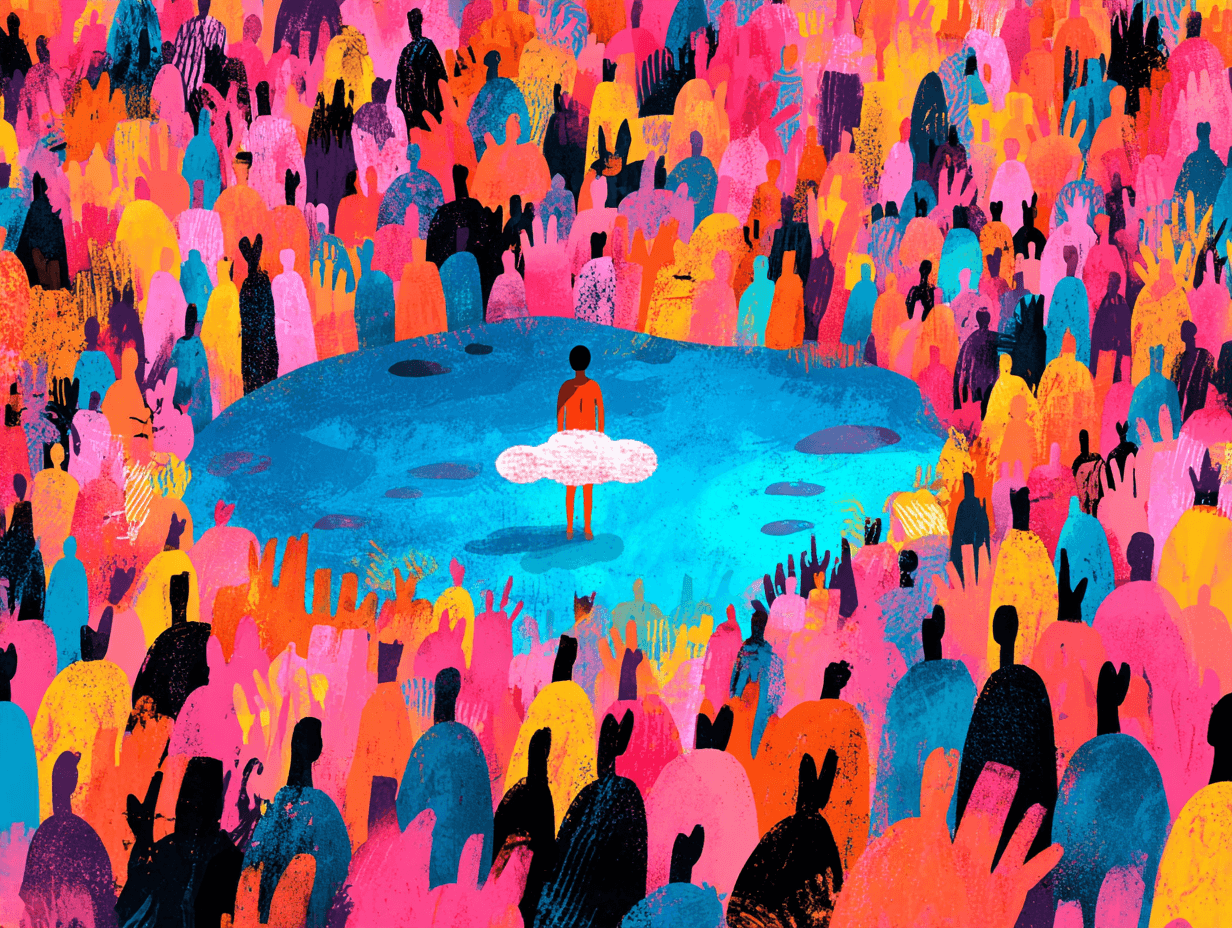
Dreaming you are naked in public is not a verdict on your body, your competence or your character. It is the mind rehearsing the feeling of being seen, and the research suggests it does that to almost everyone at some point. If you want to understand what your own version is about, write it down in Ruya and interpret it through the method that fits how you see dreams: the cognitive method for the worry it rehearses, the Jungian method for the mask it is asking you to loosen, or the Islamic and Christian methods for the questions of shame and honesty it raises. Different lenses, one dream, and an answer that belongs to you. See how the methods differ.
Naked in public dreams: questions people ask
What does it mean to dream you are naked in public?
How common are naked dreams?
Why does nobody notice I am naked in the dream?
Is dreaming of being naked a sign of anxiety?
What is the spiritual meaning of being naked in a dream?
What does being naked in a dream mean in Islam?
What does the Bible say about being naked in a dream?
How do I stop having naked dreams?
Was this article helpful?