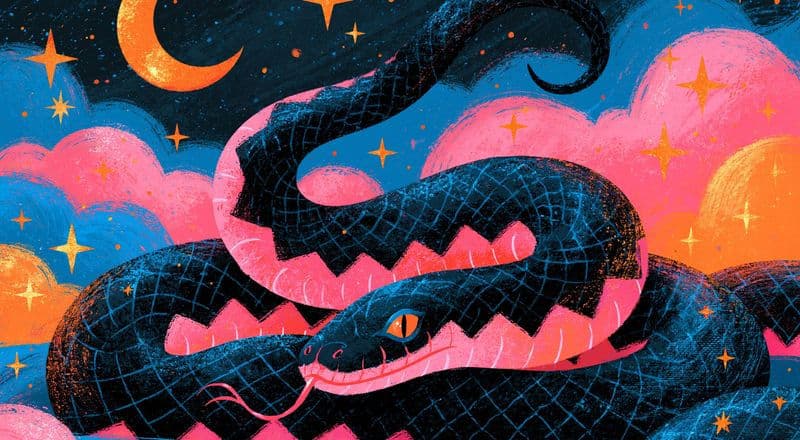
Snake Dream Meaning: Psychology, Spiritual, Islamic and Biblical Views
Few dreams wake you up quite like a snake dream. Whether it slithered past harmlessly or struck at you, the image stays vivid long after the alarm, and it sends more people searching for answers than any other dream symbol in the world. The meaning, though, depends enormously on who you ask: a psychologist, a spiritual teacher, an Islamic scholar and a Christian pastor will read the same snake very differently, and each reading can be genuinely useful. This guide walks through all of them, the most common snake dream scenarios, and what to do the morning after.
Why Snakes Rule Our Dreams
Snakes have a claim on the human imagination that is older than humanity itself. According to the snake detection hypothesis in evolutionary science, serpents were among our primate ancestors' first and deadliest predators, and the pressure to spot them helped shape the very visual system you are reading with now. Dream researchers add a second piece: one influential theory holds that dreaming evolved partly as a threat simulator, a safe overnight rehearsal of the dangers that mattered most. Put the two together and the snake is practically a house guest of the dreaming brain: the ancient threat, still being rehearsed. That is one reason snake dreams feel so charged even for people who have never seen a snake outside a screen.
One of the snakes had seized hold of its own tail, and the form whirled mockingly before my eyes.
August Kekulé, describing the dream that revealed the benzene ring (1890)
Snake dreams have even changed science: the chemist August Kekulé said the ring structure of benzene came to him in exactly this dream of a snake biting its own tail. Whatever else your snake is doing, it is in distinguished company.
What Snake Dreams Mean in Psychology
Freud, predictably, read the snake as an emblem of repressed drives and instinctual energy pushing up from below. Carl Jung took a wider view that most modern dreamworkers prefer: for Jung the serpent was one of humanity's oldest archetypes, standing for the unconscious itself, for instinct, healing and above all transformation. A creature that renews itself by shedding its skin makes a natural image for a person mid-change, and snake dreams do cluster around life transitions.
Contemporary psychology adds two grounded readings. Through the threat-rehearsal lens, a snake dream may simply be your brain running its oldest safety drill, more likely when you are stressed and vigilant in waking life. And through the continuity lens, dreams borrow from current concerns, so the snake often personifies something that quietly worries you: a health fear, a risk you are ignoring, or a person you do not fully trust. Half the world's languages call a treacherous person a snake; your dreaming mind speaks the same idiom. The details carry the message: what the snake was doing, and how you felt, matter far more than the snake itself.
What Is Your Dream Telling You?
Explore your dream through psychological perspectives — from Jungian symbols and archetypes to your everyday thoughts and worries.
Spiritual Meanings of Snake Dreams
Spiritual traditions are strikingly kinder to the dream snake than our instincts are. The shed skin makes the serpent a near-universal symbol of rebirth and transformation: a snake appearing in a dream is often read as a sign that an old identity is ready to be outgrown. In yogic traditions the coiled serpent represents kundalini, dormant life energy beginning to stir, and a snake moving up the body in a dream is taken as awakening energy. Healing runs deep in the symbol too: the serpent-entwined staff of Asclepius, from the ancient world's healing temples, is still the emblem of medicine today. And the ouroboros, the snake swallowing its own tail, stands for cycles completing and beginning again. On the shadow side, many spiritual teachers read a threatening dream snake as a warning about toxic influence: a situation or relationship quietly draining you. The common thread is honest attention: the snake marks the spot where change or discernment is being asked of you.
Snake Dreams in Islam
In Islamic dream interpretation, the tradition attributed to Ibn Sirin gives the snake one of its clearest classical readings: a hidden enemy or hostility. The details refine it. A large snake suggests a formidable adversary, a small one a lesser threat; a snake in the house points towards conflict close to home, while killing or escaping the snake is a good sign, suggesting you will overcome the enmity. A snake that leaves you untouched may mean the threat passes you by.
Two rules of the classical method temper all of this. First, context is everything: Ibn Sirin famously gave different answers to different dreamers who reported the same dream, because the dreamer's life changes the meaning. Second, Islam classifies frightening dreams carefully: a genuinely distressing dream may be hulm, a bad dream from Shaytan, and the Sunnah's guidance is to seek refuge in Allah, not to interpret it or fear it. So a terrifying snake nightmare is set aside entirely, while a calmer snake dream is weighed against your circumstances.
Snake Dreams in the Bible and Christianity
The Bible opens with a serpent, and it is not a friendly one: the snake of Genesis 3 is the great deceiver, and that association, deception, temptation, an enemy who speaks smoothly, anchors most Christian readings of snake dreams. Many modern Christian interpreters treat a dream snake as a prompt for discernment: is something false being whispered into your life, a temptation dressed up as wisdom, a relationship or habit quietly poisoning you?
Yet Scripture will not let the snake be only evil, and the nuance matters. In Numbers 21, Moses lifts a bronze serpent in the wilderness and looking at it heals the people; Jesus tells his disciples to be 'as shrewd as snakes and as innocent as doves' (Matthew 10:16). A snake dream in a Christian frame is therefore not an omen but a question: it is tested in prayer and against Scripture, and even an unsettling one is an invitation to vigilance, not a verdict of doom.
Snake Dreams in Other Cultures
- Hindu tradition: nagas, the serpent beings, are guardians of water and treasure, linked with fertility and protection. Snake dreams are read with respect rather than dread.
- Chinese tradition: in the classical Zhougong dream lore, snake dreams are frequently auspicious, associated with wealth and, in folk readings, with pregnancy omens.
- Ancient Greece: the healing temples of Asclepius kept sacred snakes, and a snake appearing in a temple dream was taken as the god's healing presence.
- Mesoamerica: Quetzalcoatl, the feathered serpent, joined earth and sky and stood for renewal, wind and learning.
Common Snake Dream Scenarios
Across all the traditions above, the scenario shifts the meaning more than anything else. Treat these as starting points and let your own circumstances finish the sentence:
| Scenario | Common reading | Worth asking yourself |
|---|---|---|
| A snake bites you | A wake-up call: a threat or truth you can no longer ignore; in Islamic readings, harm from an enemy | What have I been postponing or downplaying? |
| A snake chases you | Avoidance of something demanding attention; classic anxiety-dream pattern | What am I running from, and what happens if I turn around? |
| Many snakes at once | Feeling surrounded: multiple worries, or an environment that feels untrustworthy | Where in my life does everyone feel like a rival? |
| A snake in the house | Trouble close to home: family, household or inner life; in Ibn Sirin's tradition, a domestic enemy | What tension at home am I keeping the peace over? |
| You kill the snake | Broadly positive everywhere: overcoming a threat, temptation or fear | What battle am I closer to winning than I think? |
| A snake sheds its skin | Transformation and renewal: an old identity being outgrown | What version of me is ready to be left behind? |
| A calm snake that ignores you | A neutral or passing presence: awareness without threat; in Islamic readings, an enemy who does no harm | Am I more watchful than this situation requires? |
Colour adds a final layer, and most traditions read it similarly:
- Black: the unknown, or a fear not yet named. Often the most intense snake dreams.
- White: new beginnings, clarity, or a message trying to get through gently.
- Green: growth and healing on the bright side; envy, yours or someone else's, on the shadow side.
- Red: intensity: passion, anger or danger, depending on what the snake was doing.
- Yellow or gold: caution and wisdom in equal measure; something valuable that must be handled carefully.

What to Do After a Snake Dream
- Name the feeling first. Fear, fascination, calm, disgust: your emotion in the dream is the most reliable clue you have, more than any symbol dictionary.
- Write it down before it fades: the snake's behaviour, colour and size, where it appeared, who else was there. Details decide meanings, and they are gone by breakfast.
- Connect it to the daytime. Ask where in your life something is changing, tempting or quietly not to be trusted; the honest answer usually finds the snake.
- Choose your lens deliberately. Read it psychologically, spiritually or through your faith; they answer different questions, and you know which one you are asking.
- Do not treat it as an omen. No tradition covered here reads a snake dream as unavoidable doom; even the sternest classical readings point to something you can face and overcome.
A snake dream is a message wearing an ancient costume, and the right interpretation depends on the life it arrived in. That is exactly how Ruya works: record the dream in your free journal while it is fresh, then choose the interpretation method that matches your worldview, from psychological approaches to spiritual, Islamic and Christian traditions. A few thoughtful questions about your circumstances, the same questions the classical interpreters asked, and the snake starts to make sense.
Frequently Asked Questions About Snake Dreams
What does dreaming about snakes mean?
Is a snake dream good or bad luck?
What does a snake bite in a dream mean?
What do snake dreams mean in Islam?
What is the biblical meaning of snakes in dreams?
What does it mean to dream of many snakes?
Does a snake dream mean someone will betray me?
Can I get my snake dream interpreted online?
Was this article helpful?