Carl Jung's Dream Theory: Archetypes, Symbols and Method
No one in the twentieth century took dreams more seriously than Carl Gustav Jung. Where his mentor Sigmund Freud saw disguised wishes that needed decoding, Jung heard something stranger and more generous: a nightly letter from a deeper part of yourself, written in the oldest language humans have. A century later his vocabulary is everywhere. When people talk about their shadow, their persona, an archetype or a synchronicity, they are speaking Jung. This guide covers who he was, what his dream theory actually says, the archetypal figures he taught the world to recognise, and, most usefully, how to interpret a dream the way he would, step by step.
Who Was Carl Jung?
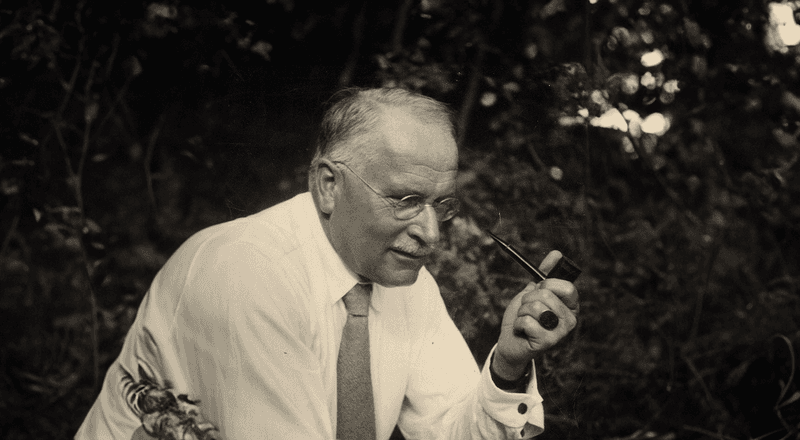
Carl Gustav Jung (1875-1961) was a Swiss psychiatrist who began his career at the Burghölzli clinic in Zurich and rose to become Freud's closest collaborator and intended successor, president of the young international psychoanalytic movement. The friendship ended famously, around 1913, over a disagreement that dreams sit at the centre of: Freud held that the unconscious is mostly a cellar of repressed personal material, while Jung had become convinced it also holds something older, a shared inheritance of images and patterns he would call the collective unconscious. After the break, Jung went through a long, difficult period of deliberately engaging his own dreams and visions, recorded in his private Red Book, and out of it built his own school, analytical psychology. He spent the rest of his life studying how myths, religions and dreams speak the same symbolic language, and finished his final project, the popular book Man and His Symbols, only after a dream persuaded him to write for ordinary readers rather than for specialists. It was published in 1964, after his death.
Fittingly, the collective unconscious itself first came to Jung in a dream. He dreamt of a house: an upper floor furnished in a fine eighteenth-century style, a ground floor that was older and darker, a cellar with Roman brickwork, and beneath it a low cave cut into bedrock, scattered with ancient pottery and two very old human skulls. Freud, hearing the dream, pressed him about the skulls and hidden death wishes. Jung drew a different conclusion: the house was the psyche, and its floors were layers of history. Below the modern rooms of consciousness lie older levels that we did not build ourselves, and dreams are how we walk down the stairs.
The Dream Theory: A Letter from the Deeper You
Jung's first break with Freud concerns what a dream is doing. For Freud, the dream disguises: a forbidden wish slips past the censor dressed as something else, and the analyst's job is to strip the costume. Jung thought the dream hides nothing at all. It is a natural product of the psyche, as organic as a heartbeat, and it says exactly what it means; it simply says it in images rather than in sentences. If a dream seems obscure, that is because we have forgotten the language, not because the dream is lying to us.
His second idea is the one practising interpreters use every day: compensation. The dream balances the waking attitude. Live too much in your head and your dreams turn earthy and bodily; play the saint all day and something disreputable will visit you at night; refuse to grieve and the grief arrives on its own schedule while you sleep. Ask of any dream, what one-sidedness in my daytime life is this the counterweight to, and you are interpreting like a Jungian. Most dreams, in his view, are small corrections of this kind. A few, which he called big dreams, feel different in kind: numinous, unforgettable, often arriving at turning points of life, and drawing on the deep shared imagery of the collective unconscious rather than on yesterday's leftovers.
In each of us is another whom we do not know. He speaks to us in dreams and tells us how differently he sees us from the way we see ourselves.
Carl Gustav Jung, Civilization in Transition
The Archetypes You Meet in Dreams
Archetypes are not images but patterns: inherited tendencies to experience life through certain universal figures and stories, the way a bird inherits the tendency to build a nest it has never seen. The images themselves are supplied by your own life and culture, which is why the same archetype wears different faces in Lagos, Istanbul and Oslo. In dreams, a handful of them return so reliably that Jung gave them names.
| Archetype | What it is | How it often appears in dreams |
|---|---|---|
| Persona | The mask you wear for the world | Clothes, uniforms, being naked in public, losing your wallet or ID |
| Shadow | The disowned parts of yourself | A pursuer, a burglar, a disliked person of your own sex, a dark figure at the door |
| Anima / Animus | The inner other: the unlived feminine or masculine side | A mysterious stranger, a guide or muse, a fascinating unknown figure |
| The Great Mother | Nourishment, origin, devouring or protective nature | Mothers and grandmothers, the sea, caves, houses, gardens, sometimes a witch |
| The Wise Old Man / Woman | Meaning, guidance, the knowledge of the psyche | Teachers, elders, doctors, hermits, a voice that gives counsel |
| The Trickster | Disruption that deflates the ego and forces change | Clowns, thieves, shape-shifters, absurd malfunctions, plans going sideways |
| The Self | The whole and centre of the psyche, the goal of individuation | Mandalas and circles, a wise child, a king or queen, a jewel, a sacred place |
One warning Jung repeated constantly: archetypes are not a dream dictionary. A snake is not "always" transformation, and water is not "always" emotion. The same image can mean opposite things for two dreamers, or for the same dreamer in two seasons of life. The pattern is universal; the meaning is personal, and it has to be earned from your own associations, not looked up in a table, including the one above, which describes tendencies rather than translations.
How Jung Actually Interpreted a Dream
Jung's method was conversational rather than mechanical. He began from the dreamer's life situation, because a dream is a comment on something, and you cannot understand the comment without knowing the conversation. He then worked outward from each dream image through what he called amplification: first the dreamer's personal associations, then, where the image seemed larger than the personal, its echoes in myth, religion and fairy tale. He preferred a series of dreams to any single dream, because the psyche circles its themes and corrects misreadings over time. And he was adamant about who holds authority: the interpretation that counts is the one that produces a felt click of recognition in the dreamer, not the cleverest reading in the room. A practical version of his approach looks like this:
- Record the dream immediately, in the present tense, with the feelings included. Detail fades within minutes of waking.
- Write down the life context. What is currently unresolved, avoided or intense? The dream is almost certainly about this, not about nothing.
- Gather associations for each image. Not chains of free association, but a circle around the image itself: what is this figure, place or object to you, in your history?
- Ask the compensation question. What attitude of mine is this dream balancing, exaggerating or contradicting? Where am I one-sided at the moment?
- Watch the series. Track recurring figures and settings across weeks. In Jung's experience the dream series interprets itself in a way no single dream can.
What Is Your Dream Telling You?
Explore your dream through psychological perspectives — from Jungian symbols and archetypes to your everyday thoughts and worries.
Jung's Legacy: Far Beyond the Consulting Room
Jung's fingerprints are on far more than dream work. The words introvert and extravert are his. The idea behind the world's most popular personality frameworks descends from his psychological types. His concept of synchronicity, meaningful coincidence, crossed into physics conversations and popular culture alike, and his practice of drawing mandalas as images of the Self turned an ancient contemplative form into a modern therapeutic tool. Within dream science his standing is debated exactly where you would expect: researchers find little evidence for a fixed symbolic code, which Jung himself also rejected, while his larger claims, that dreams are meaningful, continuous with waking concerns and useful to attend to, sit comfortably alongside modern findings. Among the eleven interpretation methods people use today, his remains the one most interpreters reach for when a dream feels bigger than the day that produced it.
Explore Your Dreams the Jungian Way
Jung compared the unconscious to a sea: personal memories near the surface, and beneath them depths that belong to everyone. A journal is how you learn to dive. Ruya's Symbols and Archetypes method is built directly on the ideas in this article: it asks you the questions a Jungian would ask, about your associations, your life situation and the feeling tone of each figure, and then reads the dream with you rather than at you. Because your dreams stay in one journal, it can also do the thing Jung valued most and almost no one manages alone: track the series, noticing when the same stranger, house or animal returns and what has changed since its last visit.

Jung's wager was simple and radical: that the psyche is self-healing, and that dreams are part of the healing. You do not have to accept every corner of his map, the archetypes, the collective depths, to test the wager for yourself. Write the dreams down, ask what they are balancing, and watch the series. Somewhere in the repetition, the other in you starts to become an acquaintance.
Carl Jung and Dreams: Frequently Asked Questions
What is Carl Jung's dream theory in simple terms?
What is the difference between Jung and Freud on dreams?
What are archetypes?
What is the shadow in a dream?
What did Jung mean by big dreams?
Do dream symbols have fixed meanings in Jungian psychology?
What is active imagination?
Is Jungian dream interpretation scientific?
Was this article helpful?