Fritz Perls' Dream Theory: Gestalt Dream Work Explained
Fritz Perls did something no dream thinker before him had dared: he took interpretation away entirely. No dictionary of symbols, no analyst decoding you from behind a couch. In Gestalt therapy the dreamer sits opposite an empty chair, brings the dream into the present tense and plays every role in it, the people, the animals, even the furniture, until the dream explains itself out loud. Perls called dreams existential messages: not riddles about your past but blunt statements about how you are living right now, delivered by parts of yourself you have disowned. This guide covers who Perls was, what his theory actually claims, how it differs from Freud and Jung, and how to run a Gestalt dream session on your own dream tonight.
Who Was Fritz Perls?
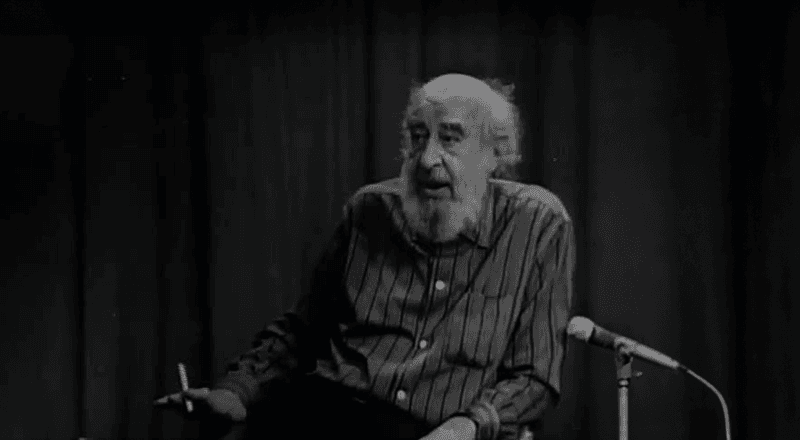
Friedrich Salomon Perls (1893-1970) was born in Berlin, served as a medic in the First World War, and trained as a psychoanalyst in the Freudian tradition he would later spend his life dismantling. Two encounters bent his path: the neurologist Kurt Goldstein, whose holistic view of the organism gave Gestalt therapy its name and its core conviction that people must be understood as wholes, and the psychoanalyst Wilhelm Reich, who taught him to watch the body, not just the words. When the Nazis took power in 1933, Perls fled with his wife and intellectual partner Laura Perls, first to the Netherlands, then to South Africa, where the two built a psychoanalytic institute and wrote the book that broke with Freud, Ego, Hunger and Aggression.
In 1951, now in New York, Perls published Gestalt Therapy: Excitement and Growth in the Human Personality with Ralph Hefferline and the writer Paul Goodman, and the new school had its founding text. But it was California that made him famous. From 1964 he lived and taught at the Esalen Institute in Big Sur, running the legendary dream seminars that were transcribed into Gestalt Therapy Verbatim in 1969, and appearing alongside Carl Rogers and Albert Ellis in the famous Gloria films, three therapists working with the same client on camera. He died in 1970, one of the most imitated and most argued-about therapists of the century.
The Dream as an Existential Message
Freud had called dreams the royal road to the unconscious. Perls answered with a deliberate correction: for him the dream was the royal road to integration. The difference is the whole theory. A dream, in the Gestalt view, is the most spontaneous thing a human being produces, a self-portrait painted with no audience in mind, and therefore the most honest existential message you will ever receive about how you are living: what you avoid, what you have left unfinished, which parts of yourself you have pushed away. Nothing in it is random, and nothing in it needs a codebook, because nothing in it is disguised. It only needs to be given its voice back.
This is why Perls took recurring dreams more seriously than any others. In Gestalt language, a situation that was never completed stays alive in the background and presses for closure, and a dream that returns is exactly that: pressure from an open loop.
If something comes up again and again, it means that a gestalt is not closed. There is a problem which has not been completed and finished and therefore can't recede into the background.
Fritz Perls, Gestalt Therapy Verbatim
If the same dream has been visiting you for years, that idea alone is worth sitting with, and our full guide to recurring dreams looks at what the research says about why they stop when the underlying situation finally changes. Perls would have smiled at the finding: the gestalt closes, and the messenger retires.
Every Part of the Dream Is You
The most radical Gestalt claim is also the most practical one: every element of the dream is a projection, a fragment of your own personality wearing a costume. Not just the people. The locked door is you. The rising water is you. The stranger who will not answer is you. In a Freudian or Jungian reading you would ask what these images mean; in a Gestalt session you become them and let them speak in the first person. A dreamer who says, as the door, "I am heavy and shut, and I decide who gets in" has done something no interpretation can do: they have heard a disowned part of themselves describe its job. Integration, the goal of the whole method, is taking these exiled fragments back, and Perls held that every re-owned fragment returns energy that was being spent keeping it at arm's length.
Freud, Jung and Perls at a Glance
| Question | Freud | Jung | Perls |
|---|---|---|---|
| What is a dream? | A disguised wish | A compensating message from the unconscious | An existential message about how you live now |
| Who interprets it? | The analyst decodes | Analyst and dreamer amplify together | Nobody: the dreamer re-enacts it |
| Key technique | Free association | Amplification, dream series | Becoming each part, chair dialogue |
| The goal | Uncover the repressed | Individuation, wholeness over a lifetime | Integration, closing unfinished business |
The three are less enemies than lenses with different focal lengths: Freud looks backward at causes, Jung looks inward and downward at the deep patterns, and Perls looks at right now: what this dream is doing in your life this week. Many working therapists borrow from all three.
How Gestalt Dream Work Actually Works
A Gestalt session has a distinctive sound: everything happens in the present tense, out loud. The dreamer retells the dream as if it is happening ("I am standing in my grandmother's kitchen, the tap is running"), because a dream narrated in the past tense stays a story, and a dream lived in the present becomes an experience that can be finished. Then the therapist invites the dreamer into the parts, often using the two-chair technique Perls made famous: sit here as yourself, sit there as the rising water, and let the two talk. Perls listened especially for the internal argument he called topdog and underdog, the bullying inner perfectionist and the sabotaging inner procrastinator whose stalemate keeps so much unfinished, and he watched the body throughout, trusting a clenched jaw over any elegant sentence. The point is never to explain the dream. The point is to finish it.
You can run an honest solo version of this with a journal and a little courage:
- Retell the dream in the present tense, out loud or in writing: "I am walking, I see, I feel." Notice how different it feels from reporting it.
- List every element, not just the people: objects, animals, the weather, the place itself. In Gestalt work the umbrella can matter more than the crowd.
- Become the strangest one first. Speak as it, in the first person, present tense: "I am the locked door. I am heavy. My job is..." Keep going past the point of feeling silly; that is usually where it gets honest.
- Stage a dialogue. Let your dream self and that element answer each other for a few exchanges, two chairs or two columns on a page. Watch for a topdog-underdog argument you recognise from daylight.
- Ask the Gestalt question: what in my life right now feels exactly like this, and what is unfinished there?
- Close a loop, however small. Send the message, have the conversation, grieve the thing, book the appointment. Perls' wager is that the dream retires when its business is done.

What Is Your Dream Telling You?
Explore your dream through psychological perspectives — from Jungian symbols and archetypes to your everyday thoughts and worries.
Legacy and Fair Criticism
Perls' fingerprints are all over modern therapy, often uncredited. Chair dialogue lives on at the heart of emotion-focused therapy and schema therapy; the here-and-now emphasis runs through mindfulness-based approaches; and virtually every experiential technique that asks a client to speak as a part of themselves descends from his dream seminars. The criticisms are just as real: the Esalen-era Perls could be theatrical and confrontational, his slogans ("lose your mind and come to your senses") aged into caricature, and Gestalt dream work has inspired far less formal research than it deserves, so its evidence base is thinner than its influence. A fair verdict is the practical one: as a claim about what dreams are, Perls is unprovable; as a method for meeting the disowned parts of yourself, becoming each part remains one of the most powerful self-reflection tools ever designed, and it works whether or not you buy the theory behind it.
Try a Gestalt Lens on Your Own Dreams
Perls' whole approach assumes you have the dream written down while it is still warm, in the present tense, with the feelings intact, which is precisely what a dream journal is for. In Ruya you can capture a dream by voice or text the moment you wake, and when you want to work with it, the interpretation methods ask the kinds of questions this article has been circling: the Life Direction and Meaning method carries the existential spirit closest to Perls, staying with what the dream says about how you are living now rather than reaching for a symbol dictionary, and the other methods are there when a different lens fits better. And because the journal notices when a dream keeps returning, you will know exactly which gestalt of yours is still open.
Of all the great dream theorists, Perls asks the least belief of you. No hidden censor, no collective depths, just a blunt proposal: the dream is yours, every piece of it, and it will tell you what it wants if you lend it your voice for ten minutes. Pick tonight's dream, choose its strangest inhabitant, and introduce yourself.
Fritz Perls and Gestalt Dream Work: Frequently Asked Questions
What is Fritz Perls' dream theory in simple terms?
What does "every part of the dream is you" mean?
What is the empty chair technique?
How is Perls different from Freud on dreams?
What are topdog and underdog?
Did Perls believe dream symbols have fixed meanings?
Why do recurring dreams matter so much in Gestalt therapy?
Can I do Gestalt dream work on my own?
Was this article helpful?