Teeth Falling Out Dream: Meaning, Science and What to Check
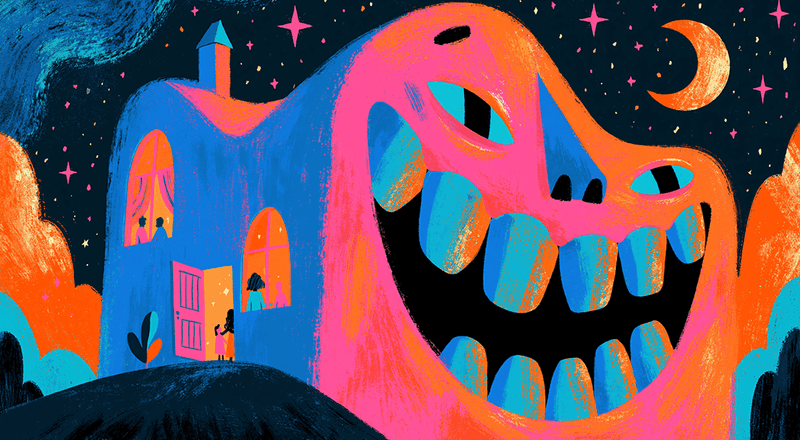
It starts with a wobble. Then a tooth comes away in your hand, then another, until you are spitting them out and clutching your mouth in a dream that feels far too real. Dreams of teeth falling out are among the most common dreams on earth, reported by roughly four in ten people, and among the most anxiously searched, because they leave a very specific dread behind. This guide takes the dream apart from every angle: what a recent study found (which is not what anyone expected), what psychology reads into it, what spiritual traditions see, how Islam and the Bible approach it, the common versions and what they tend to mean, and what to do the next morning, including one thing almost no dream guide will tell you to check.
What Science Says (It Is Not What You Think)
For a century the teeth dream was the poster child of symbolic interpretation, and everyone assumed it meant anxiety. In 2018 two Israeli psychologists, Naama Rozen and Nirit Soffer-Dudek, put that assumption to the test. They asked a large sample about their dreams, their sleep, their psychological distress and, crucially, their teeth. About 39% reported teeth dreams. The dreams did not track anxiety or general distress at all. They tracked dental irritation: people who woke with tension or tenderness in their teeth, gums or jaw were significantly more likely to have dreamed of their teeth falling out.
In other words, a large share of teeth dreams may be the body's own report: you are clenching or grinding in your sleep, and the dreaming brain weaves the sensation into a story. Freud himself had noticed dreams with a 'dental stimulus' back in 1899; the modern study simply confirmed that the mouth is often the author. That does not make the dream meaningless. It means the first question to ask is a physical one, and only then a psychological one.
Psychological Meanings of Teeth Falling Out
When the dream is not the jaw talking, psychology reads teeth through what they are to us in waking life: permanent, visible, and central to how we eat, speak and smile. Losing them in a dream therefore tends to gather around a handful of feelings:
- Loss and change: something you assumed was fixed is coming loose. Teeth dreams cluster around moves, breakups, bereavements, job changes and the end of a life stage. The wobble is the transition.
- Powerlessness: you cannot stop the teeth falling, and there is no dentist in the dream. It often surfaces when a situation feels out of your hands.
- Appearance and judgement: teeth are the first thing a smile shows. Dreams of losing them frequently arrive before interviews, dates and presentations, alongside a fear of being seen as less than whole.
- Ageing and mortality: teeth fall out at the two ends of life, and the dream can carry a quiet awareness of time passing, sometimes triggered by a birthday or a parent's illness.
- Words you cannot say: the mouth is where speech happens. A mouth full of loose teeth is a vivid picture of a conversation you are not managing to have.
As always, the feeling and the details decide which of these applies. Shame points at appearance; helplessness at control; sadness at loss. And if none of them rings true, revisit the first section: your jaw may simply be tired.
What Is Your Dream Telling You?
Explore your dream through psychological perspectives — from Jungian symbols and archetypes to your everyday thoughts and worries.
Spiritual Meanings
Spiritual traditions read the falling tooth more kindly than our instincts do. Children lose their teeth precisely in order to grow stronger ones, so the dream is widely read as a transition: an old way of being, a belief, a role or a relationship that has done its work and is ready to go, with something sturdier coming through behind it. Because teeth also shape our words, spiritual readers often connect the dream to communication, to truths you are holding back or a voice you have not fully found. And because a mouth with no teeth cannot bite, a recurring version is sometimes read as a nudge about self-worth and boundaries: where in your life have you lost your bite? The recommended response is the same across traditions: do not fear the loss, ask what is growing in its place.
Teeth Falling Out in Islam
The tradition attributed to Ibn Sirin gives teeth one of its most detailed readings, and it starts from an idea that is far older than Islam: the mouth is a house and the teeth are the people in it. In the classical texts the upper teeth generally stand for the men of the household and the lower teeth for the women, with the front teeth the closest relatives. A tooth that falls out is read in relation to the person it represents: separation, illness, a dispute or, in some readings, a death in the family. But the details matter enormously. A tooth that falls into your hand or lap and is kept is traditionally read far more gently, sometimes as long life or the arrival of a child, and loose or aching teeth are more often a family quarrel than a loss.
Two safeguards of the method apply with full force here. A frightening dream may be hulm, a bad dream from Shaytan, which the Sunnah says to seek refuge from, keep to oneself and not interpret at all. And Ibn Sirin himself gave different answers to different dreamers with the same dream, because circumstances change everything. So a Muslim who wakes from a teeth dream is advised to do the simple things: seek refuge, make du'a for the family, and not go looking for a death sentence in a dictionary.
Teeth in the Bible and Christian Interpretation
The Bible never interprets a teeth dream, but it uses teeth as images often enough to give Christian readers a vocabulary. Teeth stand for strength and the ability to take hold of things (Job describes the terrible teeth of Leviathan); 'gnashing of teeth' is anguish and regret; and Ecclesiastes 12 pictures old age as a house whose grinders have grown few. Christian interpreters therefore tend to read a dream of losing teeth as a loss of strength or confidence, a fear about words and their consequences (James 3 on the tongue), or an encounter with ageing and mortality that invites trust rather than dread. As with any dream, the counsel is to test it in prayer and against Scripture: a dream that produces panic is handed over; a dream that produces honest reflection is received.
The grinders cease because they are few, and those that look through the windows be darkened.
Ecclesiastes 12:3, describing old age (King James Version)
Teeth Dreams Across Cultures
- Ancient Greece: Artemidorus, in the second century, laid out the household reading in detail, upper teeth for the more important members of the house, lower for the rest, and even matched individual teeth to individual relatives. The Islamic tradition inherited and refined the idea.
- Chinese tradition: classical Zhougong dream lore also ties falling teeth to family, often to worry about parents or elders, which is why the dream is taken seriously rather than dismissed.
- Folk traditions from Latin America to Eastern Europe: the teeth dream is one of the classic 'death omens' of folklore, a belief so widespread that it is probably the source of much of the dread the dream causes today. No tradition's serious interpreters endorse it as a prediction.
- Everywhere: the dream itself appears in every culture studied, at roughly the same rate, which is the strongest hint that its roots are in the body and the shared human situation rather than in any one belief.
Common Versions and What They Tend to Mean
| Version of the dream | Common reading | Worth checking |
|---|---|---|
| Teeth crumbling or breaking | Something you rely on is failing under pressure; strongly linked to clenching | Jaw tension on waking; what is under strain in your week |
| Teeth falling out painlessly, one by one | Gradual change or loss; a life stage ending | What has been quietly coming loose over months |
| Pulling out your own tooth | A choice to let something go, possibly before you are ready | Whether the decision is yours or forced on you |
| Rotten, black or decaying teeth | Neglect: a problem left too long, often about health or self-care | The appointment or conversation you keep postponing |
| A mouthful of teeth you spit out | Words: things said, or unsaid, that you cannot take back | A conversation weighing on you |
| Losing a single front tooth | Visibility and judgement; in the household readings, a close relative | Whether you feel exposed somewhere right now |
| New teeth growing in | Renewal after loss; one of the most positive versions | What is replacing what you lost |
Could It Be Your Jaw? Signs of Night Clenching
Given the research, this is the check every teeth dreamer should make and almost none are told to. Night-time clenching and grinding (bruxism) is common, largely unconscious, often stress-driven, and quietly damaging. If you recognise several of these, the dream may be your most useful symptom:
- a tight, tired or aching jaw on waking, or tenderness in the teeth and gums;
- morning headaches, especially around the temples, or an ache in front of the ears;
- flattened, chipped or sensitive teeth your dentist has commented on;
- a partner who hears grinding at night;
- teeth dreams that cluster in stressful weeks and vanish on holiday.
A dentist can confirm it in one look, and a simple night guard protects your teeth while you work on the stress that drives the clenching. It is a strange thought, but for many people the correct interpretation of the teeth dream is an appointment.
What to Do After a Teeth Dream
- Check your jaw before you check a dream dictionary. Tension or tenderness on waking is a strong clue that the body wrote this one.
- Write down the version: crumbling, falling, pulled, rotten, spat out, regrowing. The variant carries most of the meaning.
- Name the feeling in the dream: shame, panic, sadness or calm. It points to which reading fits.
- Ask what is coming loose in your life, and whether you are gripping it harder than it needs.
- Let go of the omen. No serious tradition reads a teeth dream as a prediction of anyone's death, and a recurring one is far more likely to be your molars than your fate.
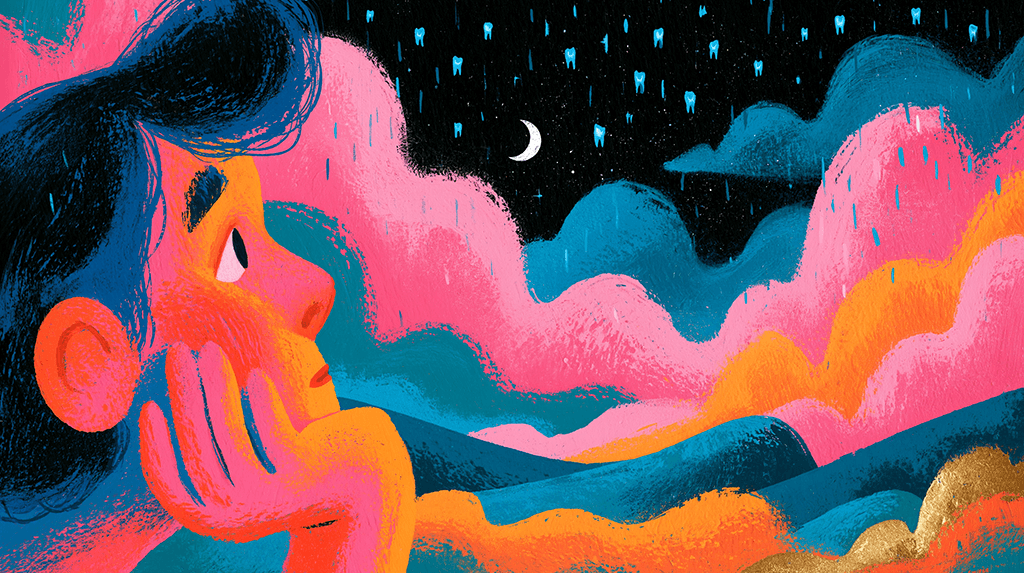
The teeth dream is a rare case where a thousand years of interpretation and a modern laboratory both have something true to say: the mouth is a house, and sometimes the house is just clenched. Record the dream in Ruya's free journal, note how your jaw felt, and if it keeps coming back, read it through the lens that fits you, from psychological methods to spiritual, Islamic and Christian traditions. A few questions about your life, and the wobble starts to make sense.
Frequently Asked Questions About Teeth Falling Out Dreams
What does it mean when your teeth fall out in a dream?
Is dreaming of teeth falling out a sign that someone will die?
Why is the teeth falling out dream so common?
What does a teeth falling out dream mean in Islam?
What does the Bible say about teeth falling out in dreams?
What is the difference between teeth crumbling and teeth falling out?
Could my teeth dreams be caused by teeth grinding?
Can I get a teeth falling out dream interpreted online?
Was this article helpful?