J. Allan Hobson: Activation-Synthesis Theory Explained
In December 1977, two Harvard psychiatrists published the most heretical idea in the modern history of dreaming: that your dreams may not be messages at all. The sleeping brainstem, they argued, fires off bursts of electrical noise, and the higher brain, caught mid-shutdown, does what it always does with incoming signals: it makes up a story. No hidden wishes, no censor, no code to crack. The paper drew furious letters, and its lead author spent the next four decades cheerfully feuding with the ghost of Sigmund Freud. Yet the strangest turn in J. Allan Hobson's story is the last one: the man who reduced dreams to noise ended his career arguing they are where consciousness itself is born. This is the theory every psychology student meets, told properly: what activation-synthesis claims, what it explains brilliantly, where it broke, and what Hobson believed in the end.
Who Was J. Allan Hobson?
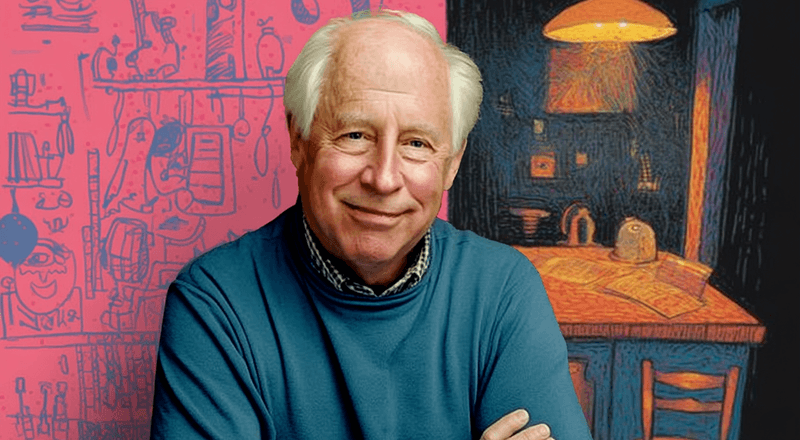
John Allan Hobson (1933-2021) was a professor of psychiatry at Harvard Medical School, where he ran the neurophysiology laboratory that mapped what brains actually do at night. Trained as a psychiatrist in the heyday of psychoanalysis, he came away a defector: the couch offered him stories about dreams, and he wanted measurements. His laboratory recorded the sleeping brainstem cell by cell, tracking the chemical tides that switch the brain between waking, deep sleep and REM. He was also a natural showman with an artist's streak: his Dreamstage exhibition toured museums with a live sleeper on display, brainwaves projected for the crowd, sleep science as performance art. And in a detail his critics relished, the great debunker of dream interpretation kept his own dream journal for decades, filling notebooks with sketches and transcripts of his nights.
His books carried the argument to the public: The Dreaming Brain, The Dream Drugstore, Dreaming: An Introduction to the Science of Sleep, and, with characteristic mischief, Thirteen Dreams Freud Never Had. In 2001 a brainstem stroke gave him the cruelest possible experiment: for weeks the world's leading REM scientist barely dreamed at all, and he studied his own broken sleep with the same rigor he had applied to his laboratory cats. He recovered, kept working from his Vermont farm, and died in 2021 at 88, still the most quoted, most argued-with figure in dream science.
Activation-Synthesis: The Theory That Started a War
The 1977 paper with Robert McCarley, The Brain as a Dream State Generator, rests on a clean two-step claim. Activation: during REM sleep a clock in the pons, the ancient stem of the brain, switches the cortex on and sprays it with powerful electrical bursts, while the body is paralysed and the senses are gated shut. Synthesis: the newly awakened higher brain receives this internally generated barrage, and, having no outside world to check it against, assembles the signals into the best story it can, stitched together from memory, emotion and expectation. The dream, in this view, is not a message that was encoded; it is a narration that was improvised. The strangeness of dreams needs no censor disguising forbidden wishes, because the strangeness is simply what a storm of brainstem signals looks like after the cortex has done its best with it.
The target was unmistakable. For most of a century, Freud's Interpretation of Dreams had taught that dream bizarreness is meaningful disguise, and an industry of symbol-decoding had grown on top of it. Hobson answered that the form of dreams comes from the form of the sleeping brain, dismissed what he called the mystique of fortune-cookie dream interpretation, and never softened his tone about it:
I don't feel bad about taking on Sigmund Freud. I think Sigmund Freud has become politically correct. Psychoanalysis has become the bible, and I think that's crazy.
J. Allan Hobson, in The Boston Globe (2011)
What the Theory Explains Beautifully
Whatever its fate as a complete account of dreaming, activation-synthesis explained the texture of dreams, the way they feel from the inside, better than anything before it. Each familiar oddity of the dream world maps onto something measurable in the REM brain:
| What dreams feel like | What the REM brain is doing |
|---|---|
| Sudden scene changes and impossible plots | The cortex improvises around chaotic bursts from the brainstem, changing the story whenever the signals change |
| Flying, falling and running in place | Balance and movement circuits fire while the body lies paralysed, so motion is felt without a body that moves |
| Vivid pictures with eyes closed | Visual areas are switched on from inside, generating imagery with no light required |
| Fear, joy and rage out of nowhere | Emotional centres, especially the amygdala, run hot during REM and colour whatever story is being told |
| Forgetting the dream within minutes | The chemicals that stamp in memories, noradrenaline and serotonin, are switched off in REM, so the recorder runs without tape |
| Accepting absurdity without blinking | The brain's critical, self-monitoring frontal regions are among the most dampened, so nothing seems strange until you wake |
The Pushback: Where the Theory Cracked
Science answered Hobson the way he wanted to be answered: with evidence. Three cracks proved the deepest. First, dreaming and REM sleep came apart: people dream in non-REM sleep too, and patients with damage to the pons can still dream, while damage to certain forebrain circuits, the ones that run wanting and motivation, abolishes dreaming even when REM survives, the case pressed by neuropsychologist Mark Solms. If dreams can outlive the generator, the generator cannot be the whole story. Second, the content: decades of systematic dream reports show dreams are far less bizarre than the theory implies, mostly ordinary people and places, continuous with the dreamer's waking concerns, and stable in their personal themes over years, which random noise should not produce. Third, the emotional patterning: dreams track what is unresolved and charged in a life with striking regularity, the finding at the heart of Rosalind Cartwright's overnight mood-repair research.
The fair verdict, and the one most sleep scientists hold today, keeps both halves. Hobson was right about the machinery: dreams are built by an internally activated brain in a unique chemical state, and no censor is needed to explain a flying dream. He overreached on meaning: the synthesis is not random, because the memories, fears and hopes the cortex reaches for are yours, chosen by an emotional brain that runs hot all night. The noise may be impersonal; the narration never is.
From Noise to Protoconsciousness: The Late Turn
Hobson never stopped revising himself, which is the most scientific thing about him. His AIM model reframed sleep and waking as positions in a three-dimensional space: how activated the brain is, whether its input comes from the world or from within, and which chemical system is in charge. Waking, dreaming, daydreaming, anaesthesia and hallucination all become neighbourhoods on one map, and the dream state stops being an anomaly and becomes a configuration.
Then came the reversal nobody expected. In 2009, in Nature Reviews Neuroscience, Hobson proposed that REM sleep is a protoconscious state: a genetically built virtual reality in which the brain simulates a world, a body and emotions, night after night, training and maintaining the very machinery of waking consciousness. The fetus, dreaming in the womb, is running the simulator before ever seeing the world. In the same years he collaborated on studies of lucid dreamers, whose distinctive frontal brain activity fascinated him as a hybrid of dreaming and waking consciousness. Follow the arc: the young Hobson said dreams are the brain making noise; the old Hobson said dreams are where consciousness rehearses itself. He never conceded an inch to the symbol dictionaries, but he ended his life convinced that dreaming, far from being froth, might be the foundation.
What Is Your Dream Telling You?
Explore your dream through psychological perspectives — from Jungian symbols and archetypes to your everyday thoughts and worries.
So Do Dreams Mean Anything, Then?
Here is the quiet resolution beneath the noise of the Freud wars. Even under strict activation-synthesis, the synthesis is personal: when your cortex improvises a story at three in the morning, it furnishes that story from your memories, your people, your unfinished business, which is why Hobson himself could fill dream journals for decades without inconsistency. The modern picture runs in both directions, a brain state that generates, and an emotional life that selects, which is why Freud's questions about what you are avoiding, and Hobson's insistence that no dictionary can answer them for you, turn out to be compatible. A dream need not be an encrypted message to be worth reading; it is at minimum an honest sample of what your brain reaches for when nobody is steering. The full map of interpretation methods shows how differently that sample can be read.
Run Your Own Experiment
Hobson's deepest habit is one anyone can copy: he treated his own nights as data. Ruya's journal makes that effortless, capture the dream by voice or text the moment you wake, before the REM chemistry erases it, and let the record accumulate. Over weeks you can test the theories on yourself: how bizarre are your dreams really, how faithfully do they track your waking concerns, which figures keep returning. The interpretation methods are there when you want to read a night more closely, and the journal's pattern detection will show you what no single dream can: what your brain reaches for, night after night, when nobody is steering.
Hobson liked to say he had taken the mysticism out of dreaming, but what he actually did was relocate the mystery: out of hidden messages, into the astonishing fact that a brain, cut off from the world, builds worlds anyway. Every night the storm rises from the stem and the storyteller upstairs gets to work. Whether you side with the storm or the story, the experiment is running in your own head tonight, and it costs nothing to take notes.
Activation-Synthesis and Allan Hobson: Frequently Asked Questions
What is the activation-synthesis theory in simple terms?
Who proposed activation-synthesis, and when?
Did Hobson believe dreams are completely meaningless?
Why do we forget dreams so quickly, according to Hobson?
How is activation-synthesis different from Freud's theory?
What is the AIM model?
What is protoconsciousness?
Is activation-synthesis still accepted today?
Was this article helpful?