
hotel_classFEATURED ARTICLE
Pregnancy Dreams: What Being Pregnant in a Dream Means
You wake with a hand on your stomach, somehow sure: in the dream you were pregnant. If you are not pregnant, the first question is whether the dream has noticed something you have not. If you are pregnant, the dream may have been even stranger: a newborn that talks, a baby you forgot on a bus. Pregnancy dreams are among the most searched dreams and unusually well studied, because for nine months researchers know exactly what the dreamer is thinking about. Here is what they found, what the dream means when you are not pregnant, how it changes through a real pregnancy, how spiritual, Islamic and biblical traditions interpret it, and what to do when it keeps coming back.
What research says about pregnancy dreams
Start with people who are actually pregnant, because that is where the research is. In 1993 two American family doctors, Blake and Reimann, asked 88 pregnant women about their dreams. Fifty-nine, 67%, had dreamed about the pregnancy or the baby, 22 had had at least one frightening dream, and the dreams grew more frequent as the pregnancy advanced. The most common single dream was an argument with the baby's father. Only two women had told their doctor.
Dream diaries confirm the pattern. Reviewing the studies in 2013, a Montreal team led by the sleep researcher Tore Nielsen estimated that 67% to 88% of pregnant women report at least one dream about a baby, a pregnancy or a birth; their own 14-night dream diaries showed third-trimester women dreaming far more often of themselves as mothers and of babies and children. In a 2014 follow-up, 21% of 57 first-time mothers in the third trimester had nightmares more than once a week, compared with 7% of non-pregnant women. A German study of 406 women in the last trimester, led by Michael Schredl, found the same raised rate of nightmares and linked it to daytime stress.
After the birth, the dreams change. Nielsen and Tyna Paquette interviewed 273 women: new mothers dreamed about the baby as often as pregnant women did, but more anxiously, more often with the baby in danger, and 57% had acted a dream out in bed, usually convinced the baby was in the sheets. None of this means something is wrong. A 2024 review of 17 studies concluded that pregnancy dreams mostly reflect waking concerns and may help women prepare for the birth. And in an often-quoted 1972 study, first-time mothers whose late-pregnancy dreams contained more anxiety had shorter labours; Patricia Garfield interpreted this as rehearsal for the birth. For people who are not pregnant there are no comparable figures; the dream has to be interpreted another way.
What the dream is usually about
When you are not pregnant, the dream is almost never about a baby. Pregnancy is the simplest picture the mind has for something growing inside you that is not finished yet and will change your life when it arrives. These interpretations apply most often.
- Something new is quietly growing. A business, a book, a house move, a relationship in its early weeks. The dream tends to arrive once you have decided for certain but not told many people, exactly the state of an early pregnancy.
- A change of identity. Pregnancy turns a person into a parent, and the dream uses that image for any change that cannot be undone. Are you ready to be the person you will be afterwards?
- Mixed feelings about children. People deciding whether to have a child, trying to get pregnant, or just told that a friend is pregnant often have this dream. Relief or disappointment on waking is the real clue.
- Carrying something heavy. A secret, a debt, a grief, a caring role. The dream makes the weight visible and, like a pregnancy, gives it an end date.
Carl Jung offered the gentlest interpretation. In myths and dreams he found that the child represents what is still emerging in a person, the unfinished part of the self; to dream of carrying a child is, in his terms, to dream of your own future on its way. Our guide to Jungian dream interpretation shows how he worked with dreams.
One of the essential features of the child motif is its futurity. The child is potential future.
C. G. Jung, The Psychology of the Child Archetype (Collected Works, Volume 9, Part 1)
Sigmund Freud approached it from the opposite direction. Dreams of water, of plunging into a lake or squeezing through narrow passages, often proved in analysis to be about birth, and his rule was to interpret them in reverse: falling into the water meant coming out of it, being born. Whatever you think of the theory, the practical point holds: water in a dream often belongs to this group of meanings. Our guide to Freud's dream theory covers the rest.
The reliable clue is how you felt: joy points to the first two interpretations, dread points to the fourth, and a quiet longing points to the third. Then find the thing in waking life at the same stage as the dream pregnancy: just discovered, visibly pregnant, or close to the birth.
Dreams during a real pregnancy, trimester by trimester
If you are pregnant now, the dream serves a different purpose, and Patricia Garfield described the pattern before most researchers did. In Women's Bodies, Women's Dreams (1988) she set out a sequence that later diary studies have broadly confirmed, and explained simply why there are so many: hormones, more sleep, more waking during dreams. "The changes in hormone levels bring on a feast of dreams in pregnant women," she said.
- First trimester. The dreams are rarely about babies yet. Garfield found them full of fertility images and, above all, water: swimming, the sea, pools, as the body itself begins to hold more fluid.
- Second trimester. As the body changes and the baby moves, the dreams become specific: the baby, the body, the partner, often the dreamer's own mother. This is where the strange dreams appear, a baby born talking, a baby that is an animal: the mind picturing a person it has never met.
- Third trimester. Specific and anxious dreams: labour, the birth, journeys and packing, forgetting or dropping the baby, something wrong with it. Bad dreams are most frequent here, and the nightmare rate roughly triples. The fear is being worked through, not predicted.
- After the birth. The dream in which you wake certain the newborn is in the bed, tangled in the sheets, is so common that it has been studied on its own. It comes from broken sleep and new responsibility, and fades as normal sleep returns.
One sentence to remember: vivid, strange, even frightening dreams in pregnancy are normal and well documented, and no dream can tell you anything about the health of the baby. If they upset you by day, or you are not sleeping, tell your midwife or doctor; both the distress and the sleeplessness can be treated.
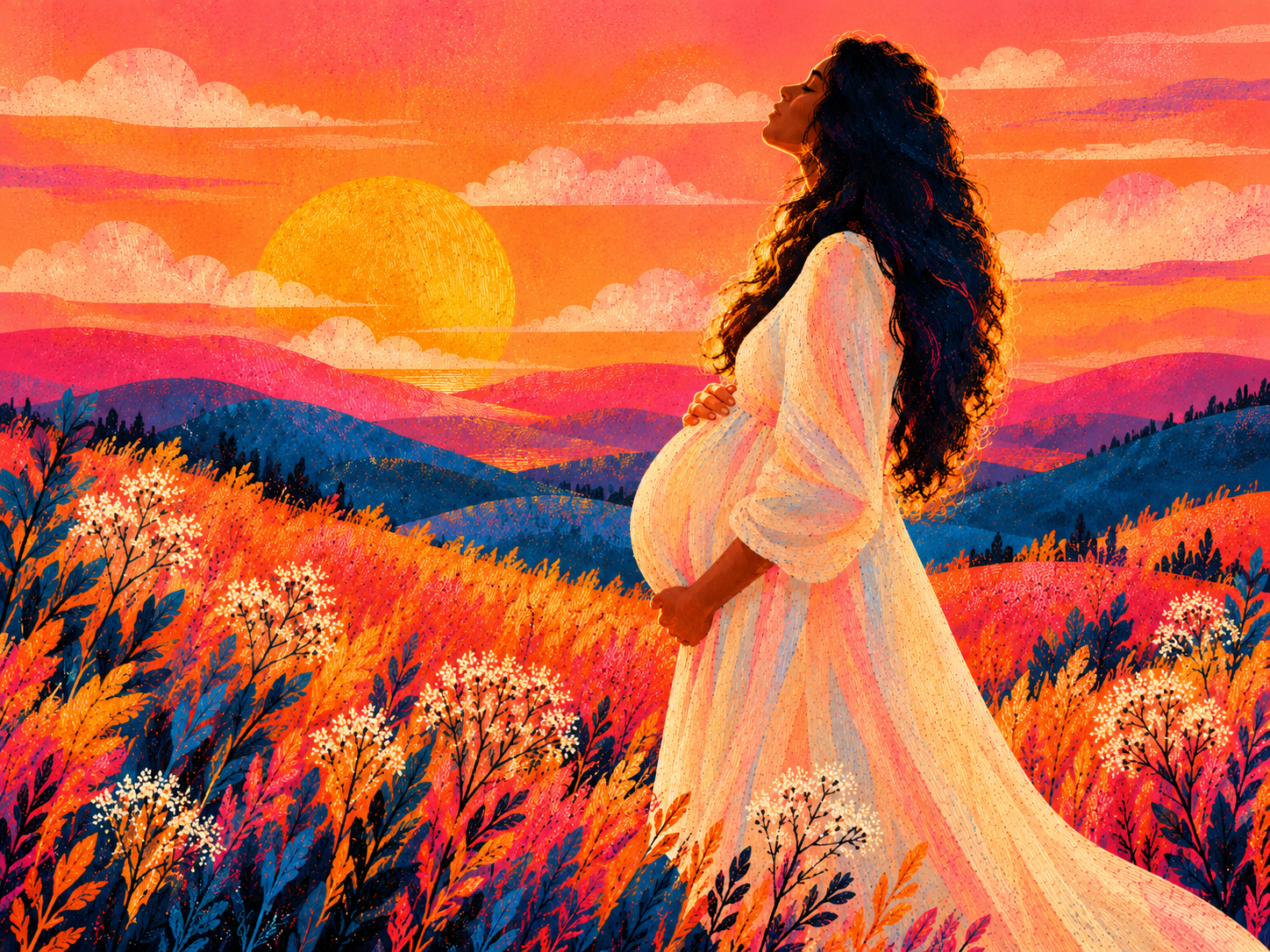
Common versions and what they tend to mean
Who is pregnant, how advanced the pregnancy is, and how you felt decide the meaning. Each version is a question, not a prediction.
| The dream | The question it tends to ask |
|---|---|
| Pregnant when you are not | The classic version. Something is at an early stage, decided on but not yet announced. How you felt on finding out in the dream is how you feel about the real thing. |
| Pregnant while actually pregnant | The mind practising for the birth. Water early on, the baby and the body in the middle months, labour and worry near the end. It says nothing about the baby. |
| Giving birth | Something arriving: a project finishing, a decision made, a new phase beginning. A hard labour points to effort; an easy one points to being ready. |
| A miscarriage or losing the pregnancy | Common in real pregnancy and among the most frightening dreams there are. It reflects the fear of losing the baby, not the likelihood of it, and predicts nothing. Outside pregnancy, it points to a stalled plan or a hope you dare not feel. |
| Someone else is pregnant | Often about that person: you sense they are changing before they have said so. Sometimes it is your own wish for a child. Folklore says they really are pregnant; there is no evidence. |
| A man dreaming he is pregnant | Rarer, and vivid. Usually a project or responsibility he is carrying and has not yet shown anyone. The classical Islamic manuals interpret it as a hidden worry. Ask what burden he is carrying. |
| Twins or more | Two things reaching completion at once, or one thing with two sides: a job and a house move, a joy and a fear. Or simply feeling doubly burdened. |
| A crying baby you cannot soothe | A need not being met, yours or someone else's. New parents dream it from exhaustion; others dream it when part of their life has been neglected. |
| Forgetting or losing the baby | One of the most common anxiety dreams of new parents, about the fear of not being good enough rather than any real risk. Outside parenthood, it points to a duty you have neglected. |
Spiritual meaning of pregnancy dreams
Spiritual interpretations of this dream are among the gentlest for any dream symbol. Almost every tradition treats pregnancy as a promise: something sacred is forming in the dreamer that has not yet been born into the world, a gift, a calling, a creative work. The dream asks for patience and protection, not action, because what is growing cannot be rushed or shown too soon. Energy traditions place it in the womb centre and interpret it as creativity waking; people who look for signs interpret it as confirmation that a path they recently chose is working.
Two warnings. The folk belief that dreaming of pregnancy means someone close to you is pregnant, or that a baby is making itself known before conception, is a much-loved family story with no evidence: the dream reflects the dreamer, not the people around you. And a pregnancy dream that fills you with dread is interpreted as a burden you did not choose. Identify it, and put down what is not yours to carry.
Discover Your Dream's Spiritual Message
Signs, synchronicities and energy — explore what your dream may be revealing on your spiritual path.
Islamic interpretation of pregnancy in a dream
Islamic dream interpretation starts with the kind of dream. The Prophet Muhammad, peace be upon him, taught that dreams are of three kinds: a good dream that is glad tidings from Allah, a distressing dream from Shaytan, and a dream that comes from what a person thinks about and dwells on (Sahih Muslim 2263). A pregnancy dream in a woman hoping to become pregnant, or in anyone who has just heard a friend's news, is of the third kind, and has no message.
The classical manuals have a well-known passage. The compilations attributed to Ibn Sirin, and the later manual of Abd al-Ghani al-Nabulsi which draws on them, interpret pregnancy in a dream as an increase in worldly goods for a man or a woman: wealth, provision, social standing; for a scholar, al-Nabulsi adds, more knowledge, and for a craftsman a new idea. A man who sees himself pregnant is interpreted in most compilations as carrying a worry he hides from others, though a minority interpretation promises him money after hardship. Interpretations about whether the dream child is a boy or a girl also exist and contradict one another: a girl is often interpreted as ease and a boy as worry, and for a woman who is actually pregnant the sex seen is often interpreted as the opposite. They are tradition and nothing more: they say nothing about the worth of a son or a daughter, and no scholar would tell a family to act on them.
The Qur'an contains the stories Muslims turn to with this dream. Maryam, promised a son, withdrew from her family; when the pains of labour drove her to a palm tree she wished she had died and been forgotten, and a voice told her not to grieve, that a stream ran at her feet and the palm would drop fresh dates (Surah Maryam 19:16-26). The wife of Imran dedicated the child in her womb to Allah and, giving birth to a daughter, named her Maryam (3:35-36). Ibrahim's wife laughed at the news of Isaac and asked how she could bear a child in old age; "Are you astonished by Allah's decree?" came the answer (11:71-73). Each is a pregnancy that arrives as a mercy, is feared or doubted, and is brought to completion. The advice never changes: a dream is never a reason to act or announce anything; if it was distressing, seek refuge in Allah and do not narrate it.
Biblical and Christian interpretations
The Bible contains the most direct passage for this dream, because the New Testament opens with a pregnancy dream. Joseph, who has learned that Mary is pregnant and means to end the engagement quietly, is visited by an angel in his sleep.
Joseph son of David, do not be afraid to take Mary home as your wife, because what is conceived in her is from the Holy Spirit. She will give birth to a son, and you are to give him the name Jesus, because he will save his people from their sins.
Matthew 1:20-21 (New International Version)
Christians draw two lessons from that scene: the dream came to calm Joseph's fear, and what is conceived is God's work, named and given a purpose before it is born. Around it the Bible is full of pregnancies that are promises. Sarah, long past hoping for a child, "became pregnant and bore a son to Abraham in his old age, at the very time God had promised him" (Genesis 21:2). Hannah vowed her child to God and "became pregnant and gave birth to a son" (1 Samuel 1:20). When Mary greeted Elizabeth, "the baby leaped in her womb" (Luke 1:41). Through Isaiah God asks, "Do I bring to the moment of birth and not give delivery?" (Isaiah 66:9), and Jesus uses childbirth as the picture of hardship before joy: the mother "forgets the anguish because of her joy that a child is born into the world" (John 16:21).
In the light of those passages, a pregnancy dream is a picture of something God is bringing to birth in the dreamer's life, often after long waiting, and the fear in it is the fear those parents felt. The right response is Joseph's: do not be afraid, and do not walk away from what you did not plan. Nobody in these stories learned of a pregnancy from a dream; the dreams came to help them face it. Our guide to biblical dream interpretation covers how believers test a dream against Scripture.
Does dreaming about pregnancy mean someone is pregnant?
No. There is no evidence that dreaming of pregnancy, your own or anyone else's, means that someone is pregnant or soon will be. The belief is old and worldwide, and survives because it is hard to prove wrong: someone in your wider circle is usually pregnant, and the dream is wrongly credited with predicting it. Dreams do notice real clues, but the clues come from you; a woman who is pregnant and does not yet know it may dream of it because her body is already changing, which is her body noticing, not the dream knowing. If a dream has made you wonder about yourself, take a pregnancy test; if you suspect a friend, ask her. On how much dreams can foresee at all, our guide to whether dreams can predict the future examines the evidence.
When pregnancy dreams keep coming back
A single pregnancy dream only reflects your week. A series of them, outside a real pregnancy, is a pattern, and like other recurring dreams it tends to stop once the thing it stands for has been dealt with. Take these steps in this order.
- Write it down the same morning. Note how advanced the pregnancy was, who knew, how you felt, and what happened to the baby. Three or four entries show the stage the dream keeps returning to, and that is where your real-life project is stuck.
- Say what is growing. Finish the sentence "The thing I am carrying and have not told people about is...". If nothing comes, try "The thing I am afraid to commit to is...". One will feel true.
- Check what happened the day before. Pregnancy dreams follow news: a friend's announcement, a pregnancy test in a film, an overdue period. Finding the trigger usually removes the feeling that the dream was a message.
- Say the real question out loud. If the dream is about children, it will keep coming until the question is at least said out loud, to yourself or a partner. You need not answer it this year, only stop pretending the question is not there.
- Give the project a deadline. If the dream is about a plan, what unsettles you is often that the plan is still vague. Tell one person. Set one date. Pregnancy dreams tend to turn into birth dreams once the project is under way.
- Get help if it will not stop. Dreams of losing a pregnancy after a real loss, dreams that leave you panicking when you wake, or pregnancy nightmares that ruin your sleep need more than a journal. A midwife, doctor or therapist will take them seriously.
Dreaming you are pregnant is not a prediction, a diagnosis or a judgement on whether you should have children. It is the mind's oldest image for something that is forming and not yet ready, and in a real pregnancy it is the mind's way of getting ready. To find out what your own dream holds, write it down in Ruya and interpret it through the method that fits how you see dreams: cognitive, Jungian, spiritual, Islamic or Christian. Different viewpoints, one dream, and an answer that is yours.
Pregnancy dreams: questions people ask
What does it mean when you dream you are pregnant but you are not?
Is it normal to have weird or scary dreams during pregnancy?
Does dreaming about pregnancy mean someone is pregnant?
What does pregnancy in a dream mean in Islam?
What does the Bible say about dreaming of pregnancy?
Was this article helpful?