True Dreams in Islam: The Meaning of Ruya Sadiqa
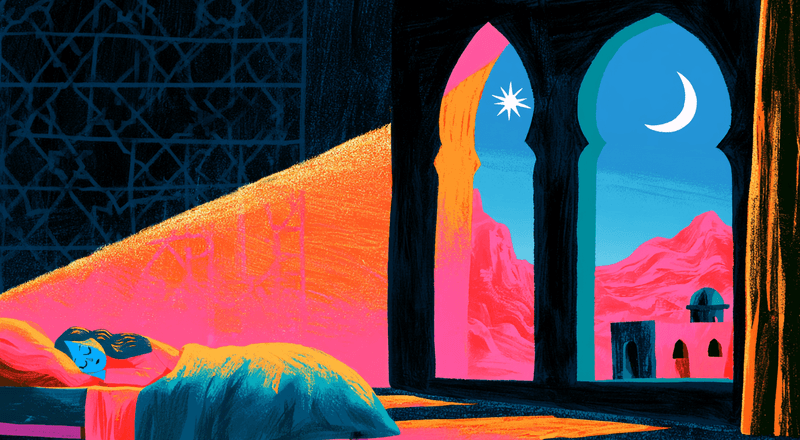
Some dreams feel different. They are clear where other dreams are chaotic, calm where others are noisy, and they stay with you after waking like something you were shown rather than something you imagined. Islam has a name for this kind of dream: al-ruya al-sadiqa, the true dream. No major tradition takes dreams more seriously, and none has built a more careful framework around them, one that honours the true dream while firmly protecting believers from fear, superstition and overinterpretation.
This guide covers the full teaching: where true dreams sit in Islam and why they are called a part of prophethood, the three types of dreams and how to tell them apart, the great dreams of the Quran, what scholars say makes a dream true, the etiquette after a good dream and after a nightmare, the truth about istikhara and dreams, and what all of this means for the question people always ask, whether a dream can really show the future.
Where True Dreams Sit in Islam
Revelation itself began with dreams. Aisha (may Allah be pleased with her) described how the first light of prophethood reached the Prophet Muhammad (peace be upon him):
The commencement of the Divine Inspiration to Allah's Messenger was in the form of good dreams which came true like bright daylight.
Aisha (may Allah be pleased with her), Sahih al-Bukhari 3
This is why the famous hadith in Sahih al-Bukhari calls the true dream of a righteous person 'one of the forty-six parts of prophethood'. Classical scholars even offered an arithmetic for the number: the period of true dreams before the angel's first visit lasted around six months, and the whole of prophethood lasted twenty-three years, and six months is one forty-sixth of twenty-three years. Whatever one makes of the calculation, the meaning of the hadith is agreed: the true dream is a small, real remnant of prophetic light. Another narration completes the picture. With the Prophet, prophethood itself ended, and he said that nothing of it remains except al-mubashshirat, the glad tidings, which he explained as the righteous dream. True dreams, in other words, are a mercy that continues: not revelation, not authority, but light.
The Three Types of Dreams
The Prophet taught, in a hadith recorded by both al-Bukhari and Muslim, that dreams are of three kinds. The first is the ruya, the good and true dream, which is from Allah: it brings clarity, comfort or guidance, and it is met with gratitude. The second is the hulm, the distressing dream, which is attributed to Satan: nightmares, disturbing images, dreams that exist to frighten or sadden the sleeper, and Islam teaches plainly that such dreams carry no power and no meaning. The third is hadith al-nafs, the talk of the self: the mind replaying its days, worries, hopes and conversations, which is neither message nor omen but simply a person, continued into sleep.
The scholars of dream interpretation, above all Ibn Sirin, were emphatic that most dreams belong to the third kind. This is not a dismissal of dreaming; it is protection. It means a Muslim is never obliged to find a message in every night's chaos, and it leaves room for what modern sleep science describes as the brain processing memory and emotion. The categories work together: humility about most dreams is exactly what makes the rare true dream worth taking seriously.
True Dreams in the Quran
The Quran's longest single story is built on dreams. As a boy, Yusuf (peace be upon him) dreams of eleven stars, the sun and the moon prostrating to him, and his father Yaqub, recognising the dream's weight, tells him not to relate it to his brothers. In prison years later, Yusuf interprets the dreams of two fellow prisoners, and then the king's dream of seven fat cows devoured by seven lean ones, reading it as seven years of plenty followed by seven of famine and advising Egypt to store grain. The interpretation saves the country, frees Yusuf and, in the end, brings his family to him; when his parents and brothers finally bow before him, he says that this is the fulfilment of his old dream. The story presents the true dream exactly as Islam understands it: real, from Allah, and understood fully only when its time comes.
The Quran also records the dream of Ibrahim (peace be upon him), who saw himself sacrificing his son and understood it as a command, a test that ended with mercy and a ransom. Here the scholars draw a line that matters for every believer: the dreams of prophets are revelation, which is why Ibrahim acted on his, but the dreams of everyone else are not. An ordinary Muslim's dream, however luminous, never creates an obligation, never overrides knowledge, and never permits what the religion forbids. A true dream may comfort, encourage or warn. It does not command.
And the Quran records one dream whose fulfilment its first readers witnessed themselves. Before the truce of Hudaybiyyah, the Prophet dreamed that he and his companions entered Makkah in safety to perform the pilgrimage. Events seemed at first to contradict the dream, and the following year proved it exact:
Certainly has Allah showed to His Messenger the vision in truth. You will surely enter al-Masjid al-Haram, if Allah wills, in safety.
Quran 48:27 (Sahih International)

What Makes a Dream True
How do you recognise a ruya sadiqa? The tradition offers signs rather than certainties. True dreams tend to be clear, simple and brief rather than sprawling and chaotic, and they leave peace behind them rather than confusion. The state of the dreamer matters: in the hadith of the three types, the Prophet added that the truest dreams belong to the most truthful in speech, and scholars have always connected honest living with honest dreaming. The tradition also gives dreams a special weight as time goes on, in the narration that as the end of time draws near, the believer's dream will hardly ever be false. And one case is unique: the Prophet said that whoever sees him in a dream has truly seen him, for Satan cannot take his form. Even there, scholars add care: what such a dream means still requires knowledge to interpret, and it grants the dreamer no authority over anyone else.
The limits are as important as the signs, and Islamic scholarship states them without embarrassment. Dreams are not evidence in law. Dreams do not add to the religion or subtract from it, because revelation is complete. No dream of an ordinary believer certifies the future, because the unseen belongs to Allah alone. What a true dream offers is bushra, glad tidings: comfort in hardship, encouragement toward good, sometimes a gentle warning that turns a heart before a mistake. Held inside those limits, the true dream is a gift with no downside. Pulled outside them, dreams have historically become tools of manipulation, which is exactly what the framework exists to prevent.
Etiquette: What To Do After a Dream
After a good dream, the teaching is simple and warm: know that it is from Allah, praise Him for it, and share it only with people you love and trust. The caution about sharing comes from the Quran itself, in Yaqub's advice to young Yusuf not to tell his brothers a dream that would stir their envy. A beautiful dream told to the wrong audience invites mockery, jealousy or clumsy interpretation, and the tradition treats a dream as something halfway fragile: it deserves a wise listener or none at all.
After a bad dream, Islam's answer is one of the most psychologically kind in any tradition, five small acts that close the door on fear:
- Seek refuge in Allah from Satan and from the evil of what you saw.
- Spit drily three times to your left, a light, symbolic puff of air.
- Turn over and sleep on your other side.
- If you remain unsettled, get up and pray.
- Tell no one about the dream. A nightmare retold is a nightmare rehearsed.
With these acts, the Prophet taught, the dream will not harm the dreamer. Notice what the etiquette quietly accomplishes: the frightening dream is stripped of authority, denied an audience and answered with action, which is close to a textbook description of how modern psychology recommends defusing nightmare distress. One further rule guards the whole system: inventing a dream one never had is described in Sahih al-Bukhari as among the worst of lies, because it forges a claim in the one place no witness can follow.
Istikhara and Dreams: A Common Misunderstanding
Ask about dreams in Islam and istikhara is never far behind. Istikhara is the prayer of seeking goodness: two units of voluntary prayer followed by a supplication asking Allah to choose what is best in a matter and to turn the heart accordingly. The widespread belief that the answer must then arrive as a dream, ideally in colours or symbols to be decoded, has no basis in the sunnah. Scholars across the schools describe the answer of istikhara as facilitation: doors opening or closing, ease or persistent unease, a heart that settles. A believer may certainly see a comforting dream after istikhara and take it as a good sign, but no dream is required, waiting for one delays decisions the prayer was meant to ease, and paying somebody to 'receive' an istikhara dream on your behalf has nothing to do with the practice at all.
So Can Dreams Predict the Future in Islam?
The Islamic answer is a careful yes, inside firm boundaries. Yes, the ruya sadiqa is real: a remnant of prophetic light, witnessed in the Quran and promised to remain among believers as glad tidings. And firmly bounded: most dreams are not messages, no dream makes law or certifies the unseen, interpretation is a skill practised with knowledge and restraint in the tradition of Ibn Sirin, and even a radiant dream is met with gratitude rather than fear. It is a framework that manages to honour the dream and protect the dreamer at once. For the other half of the picture, what statistics and sleep science say about dreams that seem to come true, see our companion guide, can dreams predict the future. The two accounts sit together more comfortably than you might expect: both counsel humility about most dreams, and attention to the ones that matter.
Islamic Dream Interpretation
Wondering what your dream means in Islamic tradition? Share your dream and receive a thoughtful interpretation rooted in Islamic sources.
True Dreams in Islam: Frequently Asked Questions
What is a ruya sadiqa?
How do I know if my dream is from Allah?
What should I do after a bad dream in Islam?
Is it haram to tell people my dream?
Does the answer to istikhara come as a dream?
What does it mean to see the Prophet Muhammad in a dream?
The true dream is one of Islam's gentlest teachings: a whisper of prophetic light left in ordinary nights, wrapped in rules that keep it safe to hold. Record your dreams, notice which kind each one is, and treat the rare luminous one with the gratitude and discretion the tradition asks. In Ruya you can keep a private, dated dream journal and explore a dream through an Islamic interpretation method built on the classical sources, alongside psychological and spiritual approaches, whenever a dream feels like more than the talk of the self.
Was this article helpful?